
14 of the Most Famous Painters—and the Pictures to Remember Them By
Match 14 famous painters with signature works, from Leonardo’s Mona Lisa to Warhol’s soup cans, then test your name recall with simple visual cues.
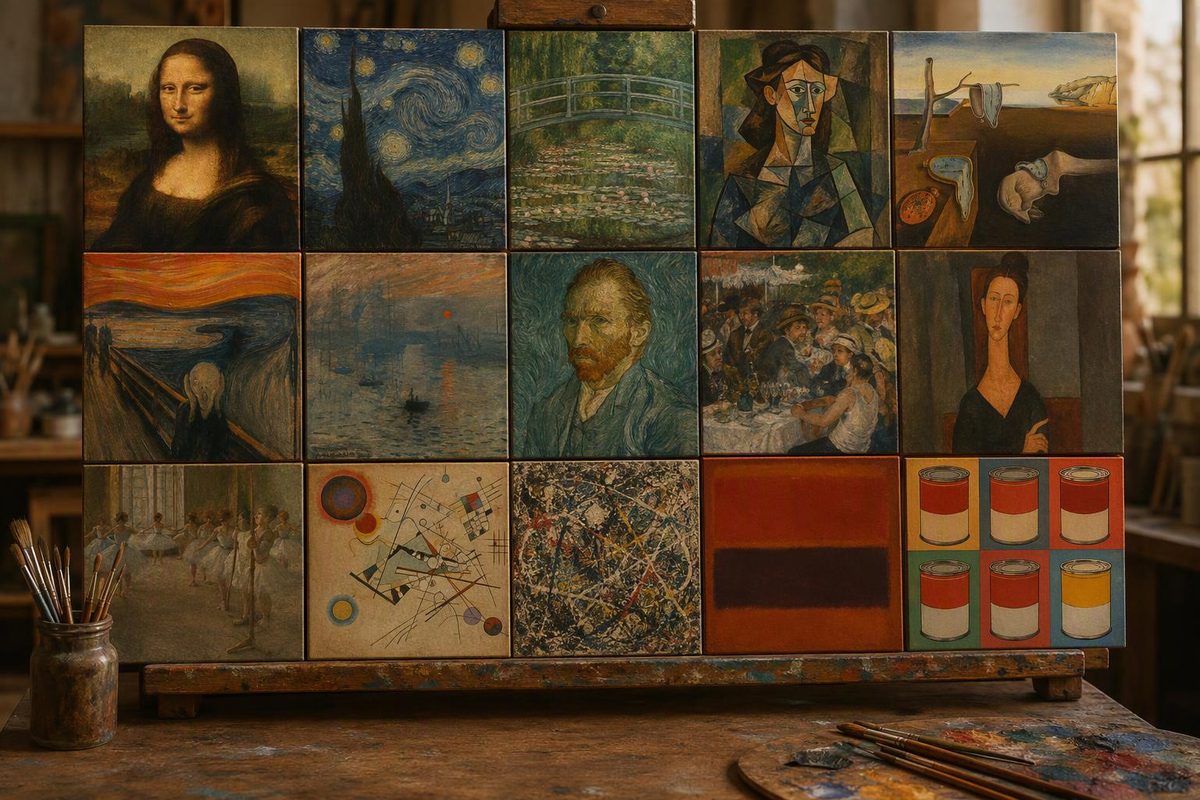
Leonardo da Vinci, Vincent van Gogh, Pablo Picasso, Claude Monet and Michelangelo are strong starting names for a famous-painters list. But can you connect each name to a picture—and retrieve the name when you see the picture?
These 14 selections pair famous painters with distinctive visual cues. They are not a measured worldwide fame ranking, and the list concentrates on European and American art rather than covering every painting tradition.
Renaissance names: a smile, a ceiling and a shell
1. Leonardo da Vinci
Recall cue: the mysterious smile. Leonardo painted the Mona Lisa, which the Louvre describes as the world’s most famous painting. Its softly blurred contours demonstrate his sfumato technique: a smoky effect rather than sharp outlines.
2. Michelangelo Buonarroti
Recall cue: look up. Michelangelo painted the Sistine Chapel ceiling, completing it in 1512. Its nine central panels tell stories from Genesis. “Michelangelo → ceiling” is a compact association to keep ready.
3. Sandro Botticelli
Recall cue: Venus on a giant shell. In The Birth of Venus, the goddess stands on a scallop shell as winds carry her toward shore. A useful trivia wrinkle: despite the title, the scene shows her arrival on land, not the moment of her birth.
Dutch painters: a crowd and a pearl
4. Rembrandt van Rijn
Recall cue: the militia gathering. Rembrandt’s The Night Watch, painted in 1642, turns a group portrait into an active scene. The captain gestures, the guardsmen assemble, and light directs attention to particular figures. Think “Rembrandt → dramatic group portrait.”
5. Johannes Vermeer
Recall cue: the pearl earring. Girl with a Pearl Earring is Vermeer’s most famous painting, according to the Mauritshuis. It is a tronie—a study of a character or type—rather than a conventional portrait intended to capture a particular person’s likeness.
Gardens, stars and fractured figures
6. Claude Monet
Recall cue: water lilies and a curved bridge. Monet built a water garden at Giverny that became the subject of some 250 paintings. The Water-Lily Pond, from 1899, shows his Japanese-style footbridge surrounded by dense greenery and reflections.
7. Vincent van Gogh
Recall cue: the swirling night sky. Van Gogh’s The Starry Night, painted in June 1889, combines observation with invention. The village was not visible from his asylum window, and he painted the nighttime scene during daytime sessions. Pair the name with those turbulent blues and bright stars.
8. Pablo Picasso
Recall cue: angular, fractured figures. Picasso’s Les Demoiselles d’Avignon, from 1907, presents five figures through flattened, splintered forms. Picasso developed Cubism with Georges Braque, although scholars debate whether this particular painting should itself be labelled Cubist.
A scream, soft watches and a self-portrait
9. Edvard Munch
Recall cue: hands over ears beneath a turbulent sky. Munch’s The Scream exists in several versions, including paintings, drawings and lithographs. For trivia, remember that the familiar image is not just one unique painted object.
10. Salvador Dalí
Recall cue: melting watches. The limp timepieces in The Persistence of Memory, painted in 1931, make an immediate cue for Dalí. The scene is dreamlike, but its distant golden cliffs refer to the coast of his home region, Catalonia.
11. Frida Kahlo
Recall cue: the self-portrait with a monkey. In Fulang-Chang and I, Kahlo connects herself and her pet monkey with a pink ribbon. She later paired the painting with a mirror. This gives you a specific picture to associate with her name, beyond simply remembering “self-portraits.”
Flowers, drips and soup cans
12. Georgia O’Keeffe
Recall cue: close-up flowers. O’Keeffe’s subjects included flowers, bones, shells and mountains. Her Jack-in-the-Pulpit paintings offer a distinctive flower cue, with details enlarged to fill the canvas. Flowers are a starting association, not the limit of her work.
13. Jackson Pollock
Recall cue: poured and dripped paint. For One: Number 31, 1950, Pollock laid canvas on the floor and poured, dribbled and flicked paint across it. Think of the dense web of paint rather than a recognizable figure or landscape.
14. Andy Warhol
Recall cue: soup cans. Warhol’s Campbell’s Soup Cans consists of 32 canvases. Despite their mechanical appearance, these particular paintings were made by hand.
Turn the pictures back into names
Cover the names above and try these five prompts: smile, pearl, lilies, swirling stars, soft watches. Then reverse the task: name a picture or subject for each painter without looking.
Use these painters as one category in the NameIt timed recall game. When that category runs dry, move to musicians, actors or athletes rather than spending the rest of the clock searching for one more painter.