
12 Famous Scientist Names With Quick Recall Cues
Match 12 famous scientist names to discoveries, books and simple recall cues—from Einstein and Curie to Rosalind Franklin and Tu Youyou.
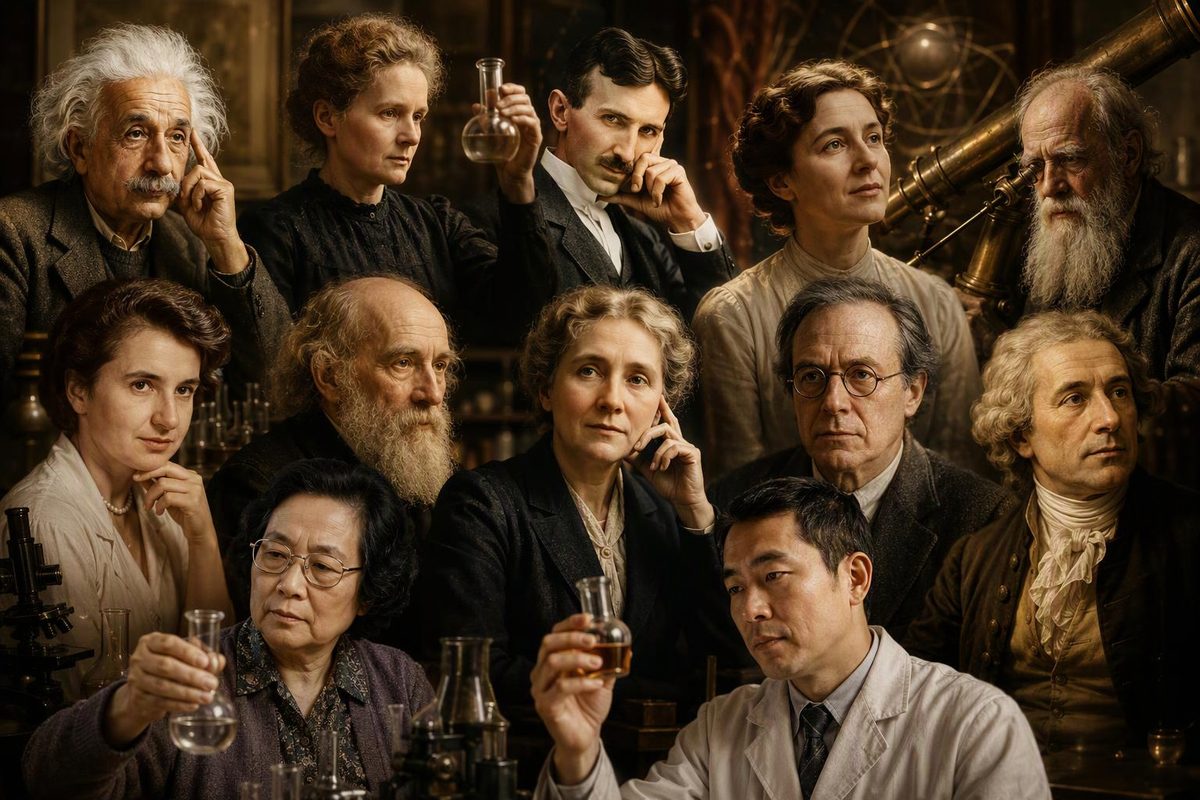
Albert Einstein, Isaac Newton, Marie Curie and Charles Darwin are useful starting points when you need famous names of scientists. But you don’t have to stop at that familiar quartet.
Here are 12 names across physics, chemistry, biology and medicine, each paired with a concrete cue. This is a recall list, not a ranking of scientific greatness.
Physics, space and matter
-
Albert Einstein — relativity. Einstein developed the special and general theories of relativity. Pair his name with relativity rather than the vague label “genius”: it gives you a specific subject to work backward from. His Nobel biography describes both theories.
-
Isaac Newton — gravity. Newton connected the force that makes objects fall on Earth with the force governing the Moon’s orbit. For a visual cue, picture the Moon continually falling around Earth, as explained in this University of Virginia physics lesson.
-
Galileo Galilei — Jupiter’s moons. In January 1610, Galileo used a telescope to identify four moons orbiting Jupiter. Picture four dots beside one bright planet. The moons are still called the Galilean satellites in his honor. NASA recounts the observations.
-
Stephen Hawking — black holes. Hawking studied black-hole physics and wrote A Brief History of Time. Either cue works: the cosmic object or the book title. Keep the spelling Stephen, not Steven. Britannica’s biography covers his research and popular writing.
-
Marie Curie — radium and polonium. Marie and Pierre Curie discovered these radioactive elements; Marie continued investigating their properties and isolated radium as a pure metal. Her quick cue is two elements, two Nobel Prizes: Physics in 1903 and Chemistry in 1911. NobelPrize.org documents both.
-
C. V. Raman — scattered light. Chandrasekhara Venkata Raman discovered that a small portion of scattered light changes wavelength, a phenomenon now called the Raman effect. Picture light entering a material and emerging slightly changed. His 1930 Nobel record gives the longer name and discovery.
Life, inheritance and animal behavior
-
Charles Darwin — natural selection. Darwin’s On the Origin of Species, published in 1859, made his explanation of evolution widely known. Use Origin of Species as the cue. Remember that Alfred Russel Wallace independently developed similar ideas: this was not a one-person story. The Natural History Museum explains their shared announcement.
-
Gregor Mendel — pea plants. Mendel used carefully controlled breeding experiments to study how traits pass between generations. Picture yellow and green peas to retrieve the name behind foundational work on inheritance. The National Human Genome Research Institute’s account describes his experiments.
-
Rosalind Franklin — Photo 51. Franklin and graduate student Raymond Gosling produced this X-ray diffraction image of DNA in 1952. Its pattern provided evidence of a helical structure. Use DNA’s X-ray pattern as the cue—not “the sole discoverer of DNA.” King’s College London describes their work.
-
Jane Goodall — chimpanzee tools. Goodall’s field research documented wild chimpanzees making and using tools. Picture a chimpanzee with a tool rather than just “animals.” Her field was ethology: the study of animal behavior. The Jane Goodall Institute tells her story.
Microbes and medicine
-
Louis Pasteur — pasteurization. Pasteur showed that heating wine could kill microorganisms responsible for spoilage and patented the process bearing his name. The word pasteurization practically supplies the surname; add Louis for the full familiar name. The Science History Institute explains the connection.
-
Tu Youyou — artemisinin. Tu extracted artemisinin from sweet wormwood, leading to an important malaria treatment and a share of the 2015 Nobel Prize in Physiology or Medicine. Pair wormwood → malaria medicine with her name. Her Nobel profile describes the discovery.
A quick name-recall challenge
Cover the list and try naming the scientists from these six cues:
Jupiter’s moons · pea plants · radium · Photo 51 · chimpanzee tools · wormwood
Then reverse the task: write each name and supply its cue. For a harder round, set a 30-second timer and recall names without looking at any prompts. If space names run dry, switch to heredity or medicine.
In the NameIt timed recall game, you start with 30 seconds and each accepted famous name adds two seconds. For example, an accepted Marie Curie entry adds two seconds to the time remaining. These names make a useful science category to practice—not a measure of how much science you understand.