
14 Famous Poet Names With Quick Recall Cues
Match 14 famous poet names with poems, books and quick recall cues—from Shakespeare and Dickinson to Rumi, Bashō, Tagore and Neruda.
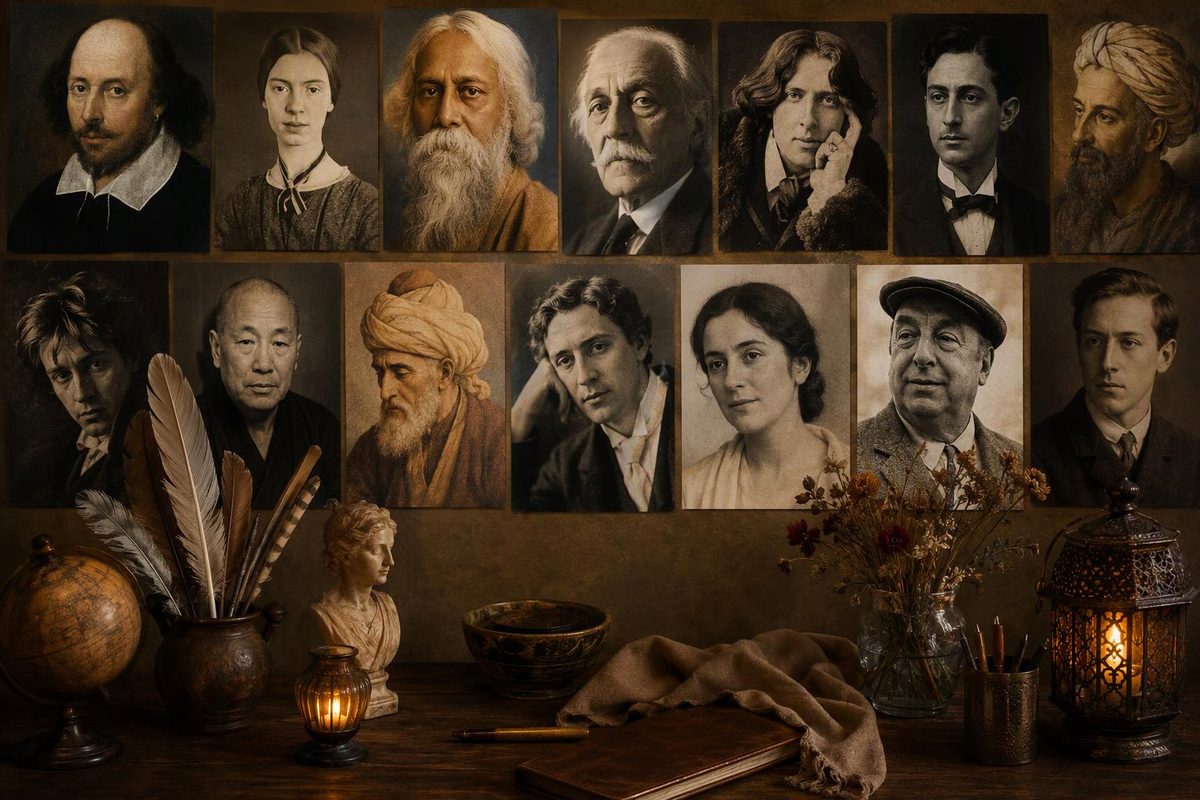
William Shakespeare, Emily Dickinson, Robert Frost, Maya Angelou and Rumi are useful starting points when you need famous poet names. But a name-only list gives you little to work with when you draw a blank. Pair each poet with a poem, a book or a distinctive image instead.
These 14 names are a starting selection across several literary traditions—not a measured ranking of worldwide fame.
Nine names in English-language poetry
-
William Shakespeare — sonnets and a summer’s day. His plays can overshadow his poetry, but his Sonnets belong on your poet list. Use the opening of Sonnet 18, “Shall I compare thee to a summer’s day?” as your cue.
-
William Wordsworth — golden daffodils. Picture the flowers beside the lake in “I Wandered Lonely as a Cloud.” That concrete scene gives you a more specific prompt than simply “an English nature poet.”
-
Emily Dickinson — hope with feathers. Her poem “‘Hope’ is the thing with feathers” imagines hope as a bird that keeps singing. Spelling check: Dickinson, not “Dickenson.”
-
Edgar Allan Poe — the raven. Think of the bird repeating “Nevermore” in “The Raven.” Poe wrote both poetry and short fiction; the bird points specifically to his poetry. His middle name is Allan, not “Allen.” (Poetry Foundation)
-
Walt Whitman — leaves of grass. His collection Leaves of Grass celebrates democracy, nature, love and friendship. For a short name-and-image pairing, use Whitman → grass. (Poetry Foundation)
-
Robert Frost — a fork in the road. “The Road Not Taken” supplies the woodland-path image; “Stopping by Woods on a Snowy Evening” offers another recognizable title. Keep the cue simple: Frost → roads or snowy woods. (Poetry Foundation)
-
Langston Hughes — the Harlem Renaissance. Hughes was a central figure in this flowering of Black literary and artistic life. Use Hughes → Harlem as your prompt, rather than trying to remember a whole biography. (Poetry Foundation)
-
Maya Angelou — “Still I Rise.” The poem’s repeated declaration makes a compact cue: Angelou → rise. It is a poetry-specific association, distinct from her autobiographical books. (Read the poem)
-
Sylvia Plath — Ariel. This poetry collection is the useful title to attach to her name. If The Bell Jar comes to mind first, keep the genres straight: that book is her novel. (Poetry Foundation)
Five names beyond English-language poetry
-
Sappho — ancient Greek love poetry. Her poems explore longing and the intensity of love, and her influence on lyric poetry has lasted across centuries. Cue: Sappho → love lyric. (Poetry Foundation)
-
Rumi — Sufi poetry and spiritual couplets. The 13th-century Persian-language poet is known for lyrical poems and the Masnavi, an epic exploring mystical teachings and divine love. Cue: Rumi → Sufi poet. (Britannica)
-
Bashō — Japanese haiku and journeys. His Narrow Road to the Interior combines prose and poetry in a travel narrative. Start with Bashō → haiku, then add the journey as a second association. (Poetry Foundation)
-
Rabindranath Tagore — Gitanjali. The Bengali poet’s own English renderings helped bring his writing to readers beyond Bengal. Pair Tagore → Gitanjali, or “Song Offerings.” (Nobel Prize biography)
-
Pablo Neruda — Chile and Canto General. His expansive collection addresses South America’s nature, people and history. Pablo Neruda was a pen name, so the familiar name—not his birth name—is the useful starting point here. (Nobel Prize biography)
Try a short recall round
Cover the list and work backward from four cues: raven, daffodils, grass, haiku. Write the poet names, then check them above. For a second round, try producing names without the cues.
To use poetry as one category in the NameIt timed recall game, start with the names you already know, then switch categories when you stall. The game starts with 30 seconds and adds two seconds for each accepted name—for example, an accepted Robert Frost entry adds two seconds to the time remaining. Treat the round as a recall challenge, not a diagnosis of memory or literary knowledge.