
12 Famous Pen Names and the Writers Behind Them
Match 12 famous pen names to their authors, from Mark Twain to Robert Galbraith, with book cues, name origins and a quick recall challenge.
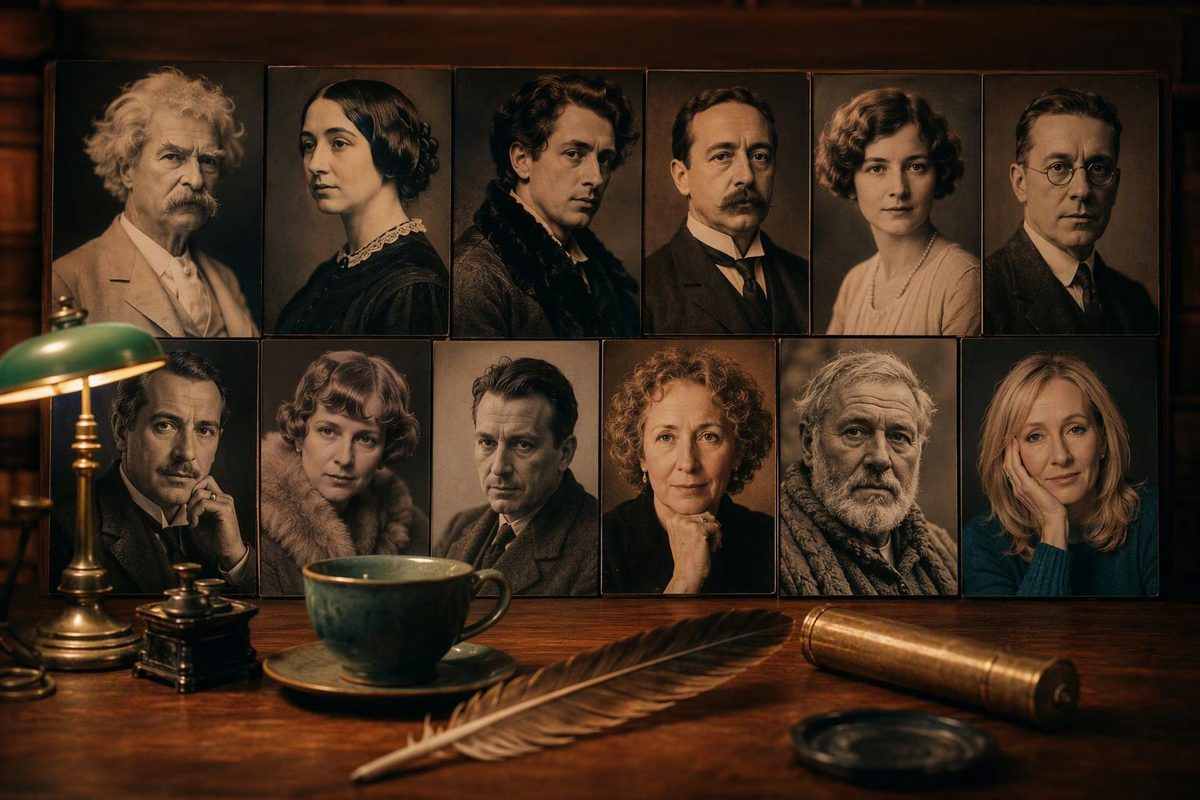
Mark Twain, George Eliot and Dr. Seuss are names readers recognize—but none was the writer’s full birth name. A pen name, also called a literary pseudonym or nom de plume, is an alternative name an author uses for their writing. (Merriam-Webster)
Some became more familiar than the names behind them. Others let established authors try something new. Here are 12 worth knowing, with a book or detail to connect each pair.
Famous pen names at a glance
The middle column gives the writer’s birth name or familiar identity; it isn’t a list of current legal names.
| Pen name | Writer behind it | Quick recall cue |
|---|---|---|
| Mark Twain | Samuel Langhorne Clemens | A river-depth call meaning two fathoms, or 12 feet. (Mark Twain House) |
| George Eliot | Mary Ann Evans | Middlemarch and Silas Marner. (Darwin Correspondence Project) |
| Lewis Carroll | Charles Lutwidge Dodgson | Alice’s Adventures in Wonderland—written by an Oxford mathematics lecturer. (Library of Congress) |
| George Orwell | Eric Arthur Blair | Animal Farm and Nineteen Eighty-Four. (Orwell Foundation) |
| Currer Bell | Charlotte Brontë | C for Charlotte; Jane Eyre. (Britannica) |
| Ellis Bell | Emily Brontë | E for Emily; Wuthering Heights. (Britannica) |
| Acton Bell | Anne Brontë | A for Anne; The Tenant of Wildfell Hall. (Britannica) |
| Dr. Seuss | Theodor Seuss Geisel | The Cat in the Hat; “Seuss” was already part of his name. (Dartmouth) |
| O. Henry | William Sydney Porter | “The Gift of the Magi” and surprise endings. (Britannica) |
| George Sand | Amantine-Lucile-Aurore Dupin | The French novelist who published Indiana in 1832. (Britannica) |
| Richard Bachman | Stephen King | Thinner—a Bachman novel later attributed to King. (Simon & Schuster) |
| Robert Galbraith | J.K. Rowling | The Cormoran Strike crime novels, beginning with The Cuckoo’s Calling. (J.K. Rowling) |
How writers used their pen names
A river call and a college workaround
Clemens adopted Mark Twain in early 1863 while working as a newspaperman in Nevada. The name referred back to his steamboating days: the crewman’s call “mark twain!” reported a depth of two fathoms. Picture a riverboat to connect Twain with Clemens. (Mark Twain House)
Geisel’s use of Seuss began at Dartmouth. After a party led the dean to order him out of extracurricular activities, including the college humor magazine, he continued contributing under “Seuss” without the administration’s knowledge. That explains the early alias—not the whole later “Dr. Seuss” name. (Dartmouth)
Three sisters, three Bells
Charlotte, Emily and Anne Brontë used Currer, Ellis and Acton Bell so their work would be judged on its merits rather than their gender, according to the Brontë Parsonage Museum. (Brontë Parsonage Museum)
The useful detail for trivia is that they kept their initials: C. B., E. B. and A. B. “Bell” wasn’t one writer publishing under three first names; each sister had her own alias. (Britannica)
A fresh start in crime fiction
Rowling says she chose a pseudonym to begin again in a different genre, without the hype and expectations attached to her existing career. Even after her identity became public, she continued as Robert Galbraith to distinguish the crime novels from her other writing. A pen name doesn’t have to remain secret to remain useful. (Robert Galbraith’s author site)
Two easy name mix-ups
- George Eliot, George Orwell and George Sand are three different writers: Evans, Blair and Dupin. Use Middlemarch, Animal Farm and Indiana as separate cues.
- O. Henry’s middle name has two documented spellings. Porter was born William Sidney Porter and later changed it to Sydney. That’s why both forms appear in references. (Britannica)
Try a quick recall round
Cover the middle column and give yourself 30 seconds to name the writers behind these six aliases: Mark Twain, Lewis Carroll, George Orwell, Dr. Seuss, Richard Bachman and Robert Galbraith. Then reverse the task: start with the writers and supply their pen names.
For a harder round, match all three Brontë sisters to their Bells—and then to their novels. For a broader challenge, move from authors to the timed famous-person recall game.