
Meet Hachikō, the Akita Who Became a Shibuya Landmark
He had a home and caregiver while returning to the station for nearly ten years. The evidence separates observed visits from precise claims added later.
Editorial note: Historical claims in this guide have been cross-checked against the supplied accounts. Station routes, institutional access and display status can change, so practical details should be verified shortly before a visit.
The short answer: the Shibuya dog is Hachikō
“Shibuya dog” usually refers to Hachikō, a male Akita associated with Shibuya Station in Tokyo. He became famous for repeatedly returning to the station after the death of his owner, Hidesaburō Ueno, in May 1925. Contemporary observation established the pattern of visits; later generations interpreted it as an expression of loyalty and devotion. A biographical overview of Hachikō summarizes the dog’s connection with Ueno and Shibuya Station.
Several names that travelers encounter refer to related but distinct things:
- Hachikō was the historical dog.
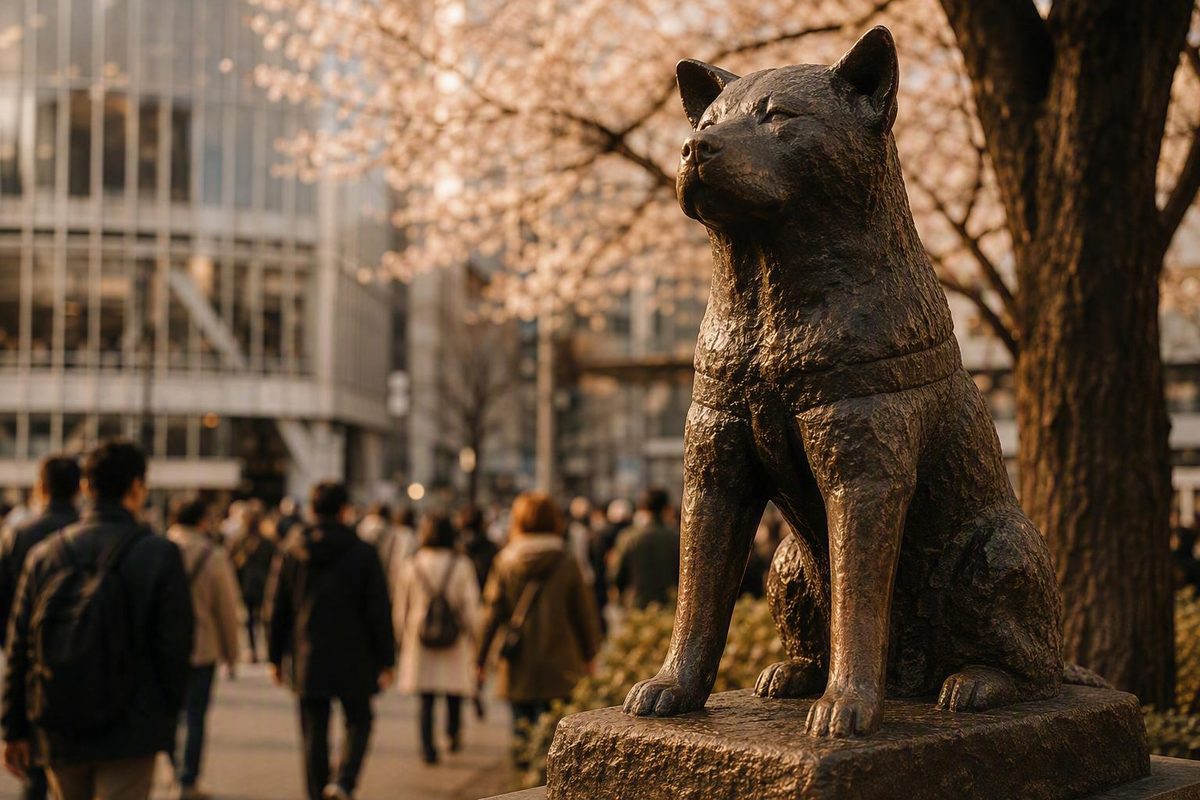
- The Hachikō statue is the bronze memorial outside Shibuya Station.
- Hachikō Square is the surrounding station plaza and meeting area.
- The Hachikō Exit is the station exit visitors generally follow to reach the memorial.
- Shibuya Scramble Crossing is the nearby intersection, not the statue plaza itself.
Ueno was a professor in the Department of Agriculture at Tokyo Imperial University, now the University of Tokyo. During their short time together, Hachikō accompanied Ueno toward Shibuya Station and returned to meet him after work. After Ueno died, Hachikō continued revisiting the place associated with that routine.
Hachikō is now culturally linked with loyalty, affection and devotion. Those words describe how people have interpreted and commemorated his conduct; they do not prove precisely what the dog understood or why he returned. The observable history is compelling without speculation: Hachikō repeatedly came back to the station where he and Ueno had met.
That can blur the distinction between documented history and emotional details added by later retellings. A careful account does not claim that Hachikō knew Ueno had died, appeared without exception every day or consciously adopted a human-like duty.
Readers looking instead for dog-friendly cafés, pet services or places to photograph live dogs in Shibuya will need a separate, current local guide. In the context of history, tourism and popular culture, the “Shibuya dog” is Hachikō.
From Akita to Tokyo: Hachikō’s life with Professor Ueno
Hachikō was born near Ōdate in Akita Prefecture in November 1923. November 10 appears frequently in popular accounts, but the supplied evidence does not establish that exact day with equal confidence. “November 1923” is therefore the more responsible date.
One of Ueno’s students helped obtain the puppy from Akita. Hachikō reached Ueno’s home in Shibuya in January 1924. Ueno was an agricultural professor at Tokyo Imperial University, and Hachikō accompanied him toward Shibuya Station before returning to meet him after work. Ueno died from a cerebral hemorrhage on May 21, 1925. These principal dates and the station routine are reported in the BBC’s account of Hachikō’s centenary.
The dog was originally called Hachi. Explanations for the name Hachi vary: different accounts connect it with the number eight, the shape of the dog’s forelegs or other circumstances. The available evidence does not justify selecting one theory as definitive.
The broad pattern of Hachi and Ueno’s routine is supported across the supplied accounts, although polished retellings sometimes turn it into a timetable more precise than the evidence warrants. It is reasonable to say that Hachikō accompanied Ueno to the station and returned to meet him; it is less responsible to assign a precise train and arrival time without a complete contemporary record.
After Ueno’s death, Hachikō did not live permanently at the station. He changed homes before being taken in by Ueno’s former gardener, who lived near Shibuya. That location gave Hachikō continued access to the station and helps explain the practical circumstances of his later visits.
The supported sequence is straightforward:
- Hachikō was born near Ōdate in November 1923.
- He arrived at Ueno’s Shibuya home in January 1924.
- He accompanied or met Ueno at Shibuya Station.
- Ueno died in May 1925.
- Hachikō later lived near Shibuya with Ueno’s former gardener.
- He continued returning to the station.
This sequence corrects the misleading image of a dog living continuously on a platform. Hachikō had a home and a caregiver. His repeated journeys to the station—not uninterrupted residence there—were the behavior that commuters observed and later writers commemorated.
Why Hachikō kept returning to Shibuya Station
After Ueno died, Hachikō repeatedly returned to Shibuya Station and continued visiting until near his own death on March 8, 1935. From May 1925 to March 1935, the safest summary is nearly ten years. Hachikō was approximately 11 years old when he died, based on the supported November 1923–March 1935 lifespan.
That wording is preferable to the frequently repeated claim that he waited for exactly nine years, nine months and 15 days. Such precision assumes a complete attendance record, an indisputable starting date and an agreed definition of “waiting.” The supplied historical accounts do not establish all three.
The distinctions matter:
- Well supported: Hachikō returned repeatedly over many years.
- Plausible but not universally documented: He returned very frequently.
- Overly absolute: He appeared every single day without exception.
- Overly precise: He always arrived for one particular train at an exact time.
The first statement captures the stable historical account. The final two belong to a polished version of the legend unless stronger station records or contemporary documentation can verify them.
Why did Hachikō return? Habit is one possible explanation. Attachment to Ueno and familiarity with their shared routine may also have mattered. Japanese writers and the public came to interpret the visits as loyalty, affection, devotion or duty. These interpretations help explain Hachikō’s cultural importance, but they are not direct evidence of his thoughts.
It is particularly risky to claim that Hachikō understood Ueno’s death yet expected him to return. Neither idea can be demonstrated from the visits alone. What can be said is that the station had been central to Hachikō’s routine with Ueno and that the dog continued returning after the human participant in that routine was gone.
The supplied sources also disagree about Hachikō’s precise cause of death, attributing it to different diseases, infections or combinations of conditions. No single diagnosis should therefore be presented as settled fact. The supported date, place and approximate age are sufficient.
Careful wording does not make the story less affecting. It focuses attention on what is both remarkable and supportable: for most of the remainder of his life, Hachikō maintained a connection with a place associated with Ueno.
How a station dog became famous across Japan
Hachikō did not become a national symbol immediately after Ueno’s death. He was first a familiar local presence observed by commuters and station workers. Local recognition, however, was different from nationwide fame.
The decisive change came in 1932, when newspaper reporting associated with the Tokyo Asahi Shimbun introduced his history to a much larger audience. After the publicity, people brought Hachikō food and treats, although that should not be generalized into a claim about every commuter’s response. The Akita Club of America’s historical account describes the newspaper coverage and subsequent public attention.
The progression from station dog to cultural symbol can be traced in stages:
- Hachikō repeatedly visited Shibuya Station.
- Local commuters became familiar with him.
- Newspaper coverage presented his history to readers across Japan.
- Hachikō became a public figure while still alive.
- A statue was unveiled at the station during his lifetime.
- Books, films, education and recurring commemoration carried the story to later generations.
The press did not create the underlying behavior. It amplified a locally observed pattern and framed it as a story of steadfastness. The statue then gave that interpretation a permanent physical form in Shibuya, while later adaptations made the story accessible to audiences with no personal connection to the station or Japan.
The Japanese title Chūken Hachikō is commonly translated as “faithful dog Hachikō” or “loyal dog Hachikō.” The expression shows how thoroughly a cultural interpretation of his conduct became attached to his public identity. Hachi was the dog’s name; Hachikō became the familiar form by which the public remembered him.
Calling Hachikō “the most loyal dog” would be misleading because loyalty has not been measured competitively across animals. His status is cultural, not statistical. Press coverage, public response, commemoration, education and adaptation collectively made him an emblem of loyalty.
Hachikō’s story inspired a Japanese film in 1987 and the American adaptation Hachi: A Dog’s Tale in 2009, as documented in a Nippon.com history of Hachikō. These productions belong to the story’s cultural afterlife; they should not be treated as documentary records of every detail.
The historical account can remain more restrained: Hachikō returned repeatedly, people noticed, newspaper coverage made the story nationally prominent, and the public interpreted the visits as an expression of devotion.
The original Hachikō statue and the bronze visitors see today
The statue outside Shibuya Station is not the original Hachikō monument.
The first bronze statue was unveiled in 1934, while Hachikō was still alive, and Hachikō was present at the unveiling. The original monument was later removed and its metal recycled during World War II. The bronze dog visitors see today is a replacement installed in 1948, not a statue that has remained continuously in place since 1934. A current history and visitor guide to the Hachikō statue summarizes this sequence.
The current bronze performs several functions at once. It is a memorial to the historical dog, a recognizable Shibuya landmark, a photograph stop and a meeting point. Its public role is much larger than its physical scale.
Visitors should expect a compact outdoor monument in a busy station plaza, not a museum-style attraction with galleries or a large exhibition. Viewing the sculpture may take only a short time. Knowing the history beforehand often gives the visit more meaning than the monument’s size alone might suggest.
Its role as a meeting point creates a practical contradiction. Hachikō is easy to name and widely recognized, which makes the statue sound ideal for a rendezvous. But when many people make the same choice, companions can be difficult to spot. Reporting on Shibuya meeting points during station redevelopment notes that crowds around Hachikō can complicate meetings.
Use the statue as the general landmark, then agree on a more exact position. Specify a side of the plaza, a visible fixed feature or another currently operating landmark nearby. “Meet at Hachikō” may not be enough, especially for people who have never visited the area.
How to find the Hachikō statue in Shibuya
The Hachikō statue stands outside Shibuya Station beside the area associated with the Hachikō Exit and close to Shibuya Scramble Crossing. Shibuya Station is served by multiple JR, private railway and metro services, as shown in the official Tokyo tourism listing for the statue.
For most visitors, the most durable directions are:
- Travel to Shibuya Station.
- Inside the station, follow current signs for the Hachikō Exit.
- Leave the station into the Hachikō plaza area.
- Look for the compact bronze dog monument.
- Continue toward the nearby Scramble Crossing if it is also on your itinerary.
This landmark-based approach is more reliable than depending on an old numerical exit designation. Shibuya is a large interchange, and the route through the station varies according to the railway or metro service on which you arrive. Platform-by-platform directions may apply to only one operator and can become obsolete.
Construction and redevelopment can also alter corridors, pedestrian flows, exit access and the shortest route to the plaza. Follow signs and station staff instructions on the day. If seeing the statue is essential, check the current information published by the railway or metro operator you plan to use.
Travel guides generally present the memorial as an outdoor public monument with no admission fee. That is not an official guarantee of uninterrupted access at every hour: temporary works, events, security controls or changes to the plaza may affect the space. A current commercial visitor guide likewise directs travelers to the Hachikō Exit and describes the statue as free to visit.
The statue and Shibuya Crossing are easy to combine because they occupy the same immediate sightseeing area. A practical sequence is to visit the memorial, orient yourself in the plaza and then walk toward the crossing. On a first visit, allow more time for navigating the station than for viewing the sculpture itself.
A few expectations will make the stop smoother:
- Treat it as a memorial and landmark. It is not a museum with galleries or interpretive rooms.
- Expect people to pause for photographs. Avoid blocking pedestrian routes while waiting.
- Make meeting instructions specific. Name a side of the plaza or a secondary landmark.
- Use current signs. Do not depend entirely on an exit number saved from an old article.
- Verify access requirements live. Current step-free routes should come from official station information.
- Do not assume facilities are attached to the statue. Check the station or nearby buildings for current restroom and service information.
No fixed hour can guarantee a quiet visit. Crowd levels vary with commuting patterns, weekends, events, tourism and construction. If photographs matter, allow flexibility rather than relying on a claim that one particular time is always empty.
Beyond Shibuya: where else to encounter Hachikō’s story
The Shibuya statue is the natural starting point, but it represents only one part of Hachikō’s history. Visitors with a deeper interest can follow a broader trail through Tokyo and, optionally, to Akita Prefecture.
Shibuya: the station story
Begin where Hachikō’s routine became public history. The statue marks his association with Shibuya Station, while the surrounding plaza shows how the story continues to function in everyday city life. This is the best stop for understanding the connection between the historical dog, the station, newspaper amplification and the modern landmark.
Aoyama: the grave connection
Remains associated with Hachikō were interred beside Ueno at Aoyama Cemetery. The site reconnects the station story with the relationship at its center. A cemetery is not simply another photograph stop, however. Visitors should confirm current guidance, respect any restrictions and behave appropriately around active graves.
Ueno: the preserved pelt
Hachikō’s preserved pelt has been displayed at the National Museum of Nature and Science in Ueno. This offers a different encounter from the stylized bronze statue because it relates directly to the physical dog behind the cultural image. Museum hours, gallery arrangements and display status can change, so verify the current exhibition information before making a special trip.
The University of Tokyo: Hachikō and Ueno reunited
A later statue at the University of Tokyo depicts Hachikō together with Professor Ueno. Unlike the solitary dog outside Shibuya Station, this sculpture imagines a reunion. Its emotional premise belongs to commemoration, while its setting recalls Ueno’s academic career.
The Aoyama interment, museum display and university reunion statue are described together in a Tokyo-focused history of Hachikō sites. University grounds are working institutional spaces, so confirm current visitor access and campus rules before going.
Ōdate: Hachikō’s origins
For travelers going beyond Tokyo, Ōdate in Akita Prefecture offers the geographical beginning of the story. Hachikō was born near the city, and Hachikō-related statues have been associated with Ōdate Station and the Akita Dog Museum area. The Akita Club of America overview identifies these monuments.
Ōdate is an optional extension rather than an addition to a normal Shibuya afternoon. It requires separate transport planning and is best suited to travelers already visiting northern Japan or those with a particular interest in Akitas and Hachikō’s origins.
A geographically organized itinerary therefore looks like this:
- Shibuya for the station story and principal statue.
- Aoyama for the burial connection with Ueno.
- Ueno for the museum display.
- The University of Tokyo for the reunion sculpture.
- Ōdate, optionally, for Hachikō’s birthplace region and related monuments.
Do not assume that all locations can be visited under the same conditions. Check museum hours, cemetery guidance, university access and transport schedules shortly before setting out.
Hachikō facts, popular retellings, and what remains uncertain
Hachikō’s story has been told so often that documented facts, cultural interpretations and dramatic additions can sound equally established. An evidence check helps separate them.
Supported by the broad historical record
The following points form the stable framework of the story:
- Hachikō was a male Akita born near Ōdate in November 1923.
- He belonged to Hidesaburō Ueno, a professor in the agriculture department at Tokyo Imperial University.
- Hachikō accompanied or met Ueno at Shibuya Station.
- Ueno died on May 21, 1925.
- Hachikō repeatedly returned to Shibuya Station after Ueno’s death.
- The visits continued for nearly ten years, until near Hachikō’s death.
- Newspaper reporting in 1932 brought him national attention.
- The first bronze statue was unveiled in 1934 while Hachikō was alive.
- The original statue was removed for wartime metal.
- The present Shibuya statue was installed in 1948.
- Hachikō died in Shibuya on March 8, 1935, at approximately 11 years old.
The supported November 1923–March 1935 lifespan, principal station history and approximate age at death are summarized in the biographical account of Hachikō.
Uncertain or overly precise
The exact day of Hachikō’s birth: November 10 appears frequently, but the stronger supplied evidence supports November 1923 rather than a confirmed day.
An exact number of days spent waiting: Calculating a total from two dates does not prove attendance on every intervening day. It also does not settle when the post-Ueno routine should be considered to have begun.
Daily attendance without exception: Repeated and long-running station visits are well established. “Every single day” requires a more complete record.
Arrival for a precisely timed train: This detail produces a satisfying narrative but should not be presented as universally documented fact.
The definitive origin of the name Hachi: Several explanations circulate, and the evidence does not establish one conclusively.
Interpretations rather than observable facts
“Loyalty,” “devotion,” “affection,” “habit” and “duty” are interpretations of Hachikō’s conduct. They may help explain why the story resonated, but none provides direct access to his mental state.
Likewise, statements that Hachikō understood Ueno had died, believed he would return or consciously chose to honor him go beyond the evidence. The station visits can be documented; the precise thoughts behind them cannot.
This does not make cultural interpretation illegitimate. Hachikō became important because people understood his repeated returns through ideas of constancy and attachment. The essential distinction is between the meaning society assigned to the behavior and a scientifically knowable account of one dog’s motives.
Claims on which sources conflict
Hachikō’s cause of death: The supplied accounts mention different diseases, infections or combinations of conditions. No single version should be treated as definitive here.
The most specific description of Ueno’s fatal condition: Cerebral hemorrhage is the prudent wording. More detailed formulations vary among accounts.
The annual remembrance date: Published sources do not agree. One Tokyo travel history reports a ceremony on March 8, while other accounts place it in April. The travel history giving the March date illustrates why anyone hoping to attend should verify the official schedule for the relevant year rather than rely on a permanent date in a general article.
Incorrect or misleading versions
Saying Hachikō died at age 12 or 13 is inconsistent with the supported November 1923 birth month and March 1935 death date. He was approximately 11.
It is also incorrect to call the statue outside Shibuya Station the original 1934 bronze. The current monument is the postwar replacement installed in 1948.
Finally, “Hachikō waited at the station for ten years” can suggest uninterrupted residence. “He repeatedly returned for nearly ten years” is more accurate. It recognizes both the duration of the pattern and the fact that Hachikō had a home away from the station.
Careful wording strengthens the story rather than draining it of emotion. Hachikō does not need a disputed birthday, an exact attendance total or invented access to his thoughts to remain remarkable.
Frequently asked questions
What breed was the Shibuya dog Hachikō?
Hachikō was a male Akita, also called an Akita Inu. He was born near Ōdate in Akita Prefecture. Although November 10 is frequently repeated, the supplied evidence securely supports only November 1923.
How long did Hachikō wait at Shibuya Station?
Nearly ten years is the safest summary of the period between Ueno’s death and Hachikō’s final months. It is more accurate to say that he repeatedly returned than that he waited continuously or followed a perfectly documented daily schedule.
Where is the Hachikō statue, and which station exit should I use?
The statue is outside Shibuya Station, close to Shibuya Scramble Crossing. Follow the station’s current signs for the Hachikō Exit; the official Tokyo tourism guide also identifies the memorial as accessible from Shibuya Station.
Avoid relying exclusively on an old exit number or route description. The best path depends on the railway or metro service by which you arrive, and station access can change.
Is the Hachikō statue in Shibuya the original one?
No. The original bronze was unveiled while Hachikō was alive and was later removed for wartime metal. The statue now outside Shibuya Station is the postwar replacement, not the same bronze.
Where are Hachikō’s grave and preserved remains?
Remains associated with Hachikō were interred beside Professor Ueno at Aoyama Cemetery. His preserved pelt has been displayed at the National Museum of Nature and Science in Ueno, according to the Nippon.com historical overview.
Check current cemetery guidance and museum information before visiting. Access rules, gallery arrangements and display status can change.
The “Shibuya dog” is Hachikō, but his significance extends beyond a convenient search term or photograph stop. The documented story is that an Akita repeatedly returned to Shibuya Station after his owner’s death, became nationally known through newspaper coverage in 1932 and was commemorated by a statue whose present version dates from 1948. Visitors can follow current signs to the Hachikō Exit, approach the compact and often busy memorial with realistic expectations, and remember that Hachikō’s legacy does not depend on disputed dates, exact day counts or assumptions about what he thought.