
What Lightsaber Colors Really Tell You—and What They Do Not
The familiar blue-Guardian, green-Consular, and yellow-Sentinel system comes from Legends. Canon origins and fan interpretations are kept separate.
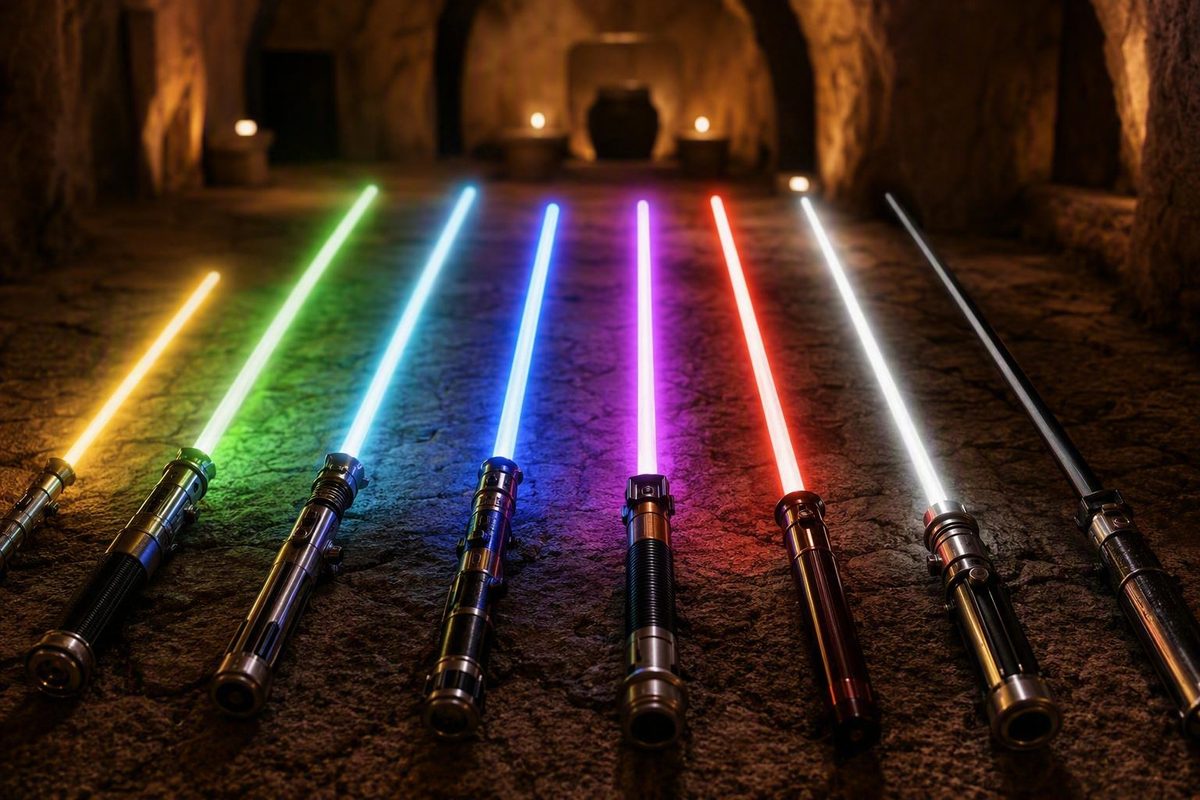
The short answer: most lightsaber colors have no fixed canon meaning
Star Wars does not provide a universal canon chart in which every lightsaber color reveals its wielder’s personality, occupation, fighting style, Force abilities, or moral alignment.
Some colors do have well-established associations or origins. Red blades are associated with Sith and dark-side corruption. Ahsoka Tano’s white blades resulted from healing corrupted crystals. Yellow blades are associated with Jedi Temple Guards. Blue and green are common among Jedi. But those facts do not turn every color into a personality category.
-
How did the crystal acquire or change its color? Red and white have the clearest answers in the cited canon material.
-
Who is known for carrying that color? Purple is strongly associated with Mace Windu, while black is represented principally by the Darksaber.
-
What did an older continuity associate with the color? The familiar blue-Guardian, green-Consular, and yellow-Sentinel system comes from Legends.
-
What symbolism has been inferred from the color? Claims such as “purple means balance,” “white means neutrality,” and “orange means mixed alignment” are interpretations unless a story or authoritative reference establishes them.
A famous user does not create a universal rule. Mace Windu carrying purple does not mean every purple-blade wielder shares his temperament, techniques, or relationship with the Force. Likewise, the Temple Guards’ yellow weapons do not prove that all yellow-blade users have one personality or profession.
This guide uses five labels to keep those distinctions visible:
- Canon-confirmed: A mechanism, event, or association established in the canon material represented by the cited evidence.
- Legends association: A convention or account from the older Expanded Universe continuity.
- Production history: An out-of-universe reason a color was selected for a film or character.
- Interpretation: A thematic reading rather than an established rule.
- Unknown: No universal meaning is established by the material covered here.
The scope is limited to major colors documented in the supplied evidence. It is not an exhaustive inventory of every shade in games, merchandise, effects work, or customization menus.
There is also an important evidence limitation: the available sources are secondary—a community Q&A, a fan-maintained reference page, and a commercial lore article published in 2022. They do not provide a complete update on every later Star Wars release. Accordingly, statements about unresolved meanings apply to the cited material rather than claiming that every development through 2026 has been authoritatively checked.
Canon versus Legends: why the same color can have two answers
Contradictory lightsaber charts often draw from different continuities without labeling them.
Legends remains relevant to the history of popular color meanings, but its conventions are not automatically rules of current canon.
In the canon material quoted by a Science Fiction & Fantasy Stack Exchange overview of lightsaber colors, a kyber crystal begins colorless and acquires a hue through attunement to a Jedi and the Force. It usually becomes blue or green, although other colors are possible. The account establishes a relationship among the crystal, the Jedi, and the Force, but it does not provide a trait chart explaining why ordinary attunement produces one particular non-red hue rather than another.
It is therefore too strong to say that every Jedi can consciously select an uncorrupted crystal’s final color as though choosing paint. It is also unsupported to assume that a lightsaber automatically changes color whenever it gets a new owner. The cited material establishes attunement but does not resolve every question of choice, transfer, or causation.
Legends treated construction more broadly. Crystal selection, availability, synthetic production, and unusual focusing materials could influence blade color and behavior. Jedi generally used natural crystals, while Sith commonly created synthetic red ones. A builder who lacked access to a customary crystal could use another suitable material, potentially producing a color unrelated to a formal Jedi role.
The familiar class convention belongs primarily to this older continuity:
- Blue: Jedi Guardian
- Green: Jedi Consular
- Yellow: Jedi Sentinel
The scheme was recognizable in certain Legends eras and games, but it was not a timeless sorting law. The distinctions later became less rigid, while crystal supplies helped make blue and green common regardless of class.
Legends crystal note: “Lightsaber crystal” is useful shorthand, but not every focusing component in Legends was literally a mineral crystal. Physical remains, manufactured components, glasslike substances, and other materials could sometimes serve similar functions. Some components could also affect blade properties rather than color alone, according to the Wookieepedia overview of Legends lightsaber crystals. Those mechanical effects did not create a universal symbolic dictionary.
The core distinction is straightforward: the cited canon account emphasizes kyber and attunement, including special transformations associated with red and white. Legends allowed a wider relationship among chosen materials, available supplies, synthetic production, class conventions, and specialized effects.
Lightsaber color meanings at a glance
The most accurate quick-reference guide separates crystal mechanisms, institutional use, Legends classifications, famous users, production choices, and speculation.
| Color | Current-canon significance in the cited material | Legends association | Notable user or group | Confidence level | Common misconception |
|---|---|---|---|---|---|
| Blue | Common Jedi blade color; no fixed personality or occupational meaning established | Associated with combat-oriented Jedi Guardians | Numerous Jedi | Canon-confirmed | “Every blue wielder is officially a Guardian.” |
| Green | Common Jedi blade color; no universal distinction from blue based on wisdom, diplomacy, or Force strength | Associated with contemplative and diplomatic Jedi Consulars | Numerous Jedi | Canon-confirmed | “Green canonically means wisdom or spirituality.” |
| Yellow | Associated with Jedi Temple Guard weapons | Associated separately with Jedi Sentinels | Jedi Temple Guards | Canon-confirmed | “All yellow wielders have a Sentinel personality.” |
| Red | Created when a dark-side user corrupts or “bleeds” kyber; strongly associated with Sith and the dark side | Sith commonly used synthetic red crystals, although rare natural red materials could exist | Sith and other dark-side users | Canon-confirmed | “Every red blade in every continuity was bled.” |
| White | Ahsoka’s blades resulted from healing previously corrupted red crystals | No universal formal alignment category established | Ahsoka Tano | Canon-confirmed | “White officially means Gray Jedi or neutrality.” |
| Purple | Most prominently associated with Mace Windu; no universal symbolism established | Could arise from rare crystals or materials | Mace Windu | Production history | “Purple proves that the wielder balances light and dark.” |
| Black | Represented principally by the distinctive Darksaber | Tied primarily to the Darksaber’s history | Darksaber wielders | Unknown | “Black universally means evil or dark-side alignment.” |
| Orange | Available as a color in Jedi: Fallen Order; that option alone establishes no universal narrative meaning | One limited account associates it with seeking peaceful resolutions near conflict | Player-selectable appearance | Unknown | “Orange officially means mixed alignment.” |
| Pink | No universal canon meaning established in the cited material | Rare crystals associated with Kinrath eggs on Dantooine | No defining universal user | Legends association | “Pink has a confirmed emotional meaning.” |
| Turquoise | No universal canon meaning established in the cited material | Exceptionally rare and associated with materials such as Sunrider’s Destiny or rainbow gems | Rare Legends examples | Legends association | “Turquoise means a midpoint between Guardian and Consular.” |
The table is intentionally uneven. Red and white can be discussed through documented crystal transformations. Blue, green, and yellow combine common usage or institutional identity with older class associations. Purple and black are understood most securely through a particular character or object. Rare colors may have documented appearances or materials without possessing confirmed symbolic meanings.
“Unknown” does not mean “irrelevant.” It means that appearance, origin, user, and symbolism should not be treated as interchangeable.
Blue, green, and yellow: Jedi colors and the Legends class system
Blue and green are among the most familiar Jedi blade colors. In the cited canon material, however, there is no dependable rule separating blue-blade Jedi from green-blade Jedi by temperament, rank, combat specialty, profession, or Force ability.
A blue blade may evoke action-oriented heroes because prominent combatants have carried one. A green blade may suggest contemplation because well-known Jedi such as Yoda and Qui-Gon Jinn carried green. Those patterns can matter in visual storytelling, but they do not amount to a universal canon classification.
Blue and Jedi Guardians in Legends
The older Legends class convention associated blue with Jedi Guardians. Guardians emphasized combat training and physical applications of the Force. They were commonly framed as Jedi who confronted threats directly and developed the martial side of their calling.
This association explains why many color charts define blue with words such as bravery, protection, action, or combat. Those words approximate the Guardian archetype, but the chart becomes misleading when it omits the Legends label or presents Guardian status as a rule for every blue blade.
The more accurate formulation is:
Blue was associated with Jedi Guardians in an older Legends class system; that does not make every blue-blade wielder a Guardian in current canon.
Even in Legends, blade color was not conclusive psychological evidence.
Green and Jedi Consulars in Legends
Green was associated with Jedi Consulars. Consulars placed greater emphasis on studying the Force, contemplation, diplomacy, planning, and nonviolent problem-solving.
That archetype is the source of claims that green universally represents wisdom, spirituality, harmony, or diplomatic skill. These are descriptions derived from the Consular role, not a demonstrated law of canon crystal behavior.
A green blade does not by itself prove that its wielder is wiser than a blue-blade Jedi, less capable in combat, stronger in the Force, or assigned to diplomacy. Those conclusions require evidence from the character’s actions and story.
Yellow and Jedi Sentinels in Legends
Yellow was associated with Jedi Sentinels, who occupied a conceptual space between Guardians and Consulars. Sentinels combined Force training with practical expertise and could develop technical, investigative, security-related, or other nontraditional skills.
This role helps explain why yellow is sometimes defined as versatility, persistence, balance, or practical intelligence. Those terms summarize an older class archetype; they are not universal properties encoded in every yellow crystal.
The class-color convention later became less rigid. As access to crystal sources changed, availability increasingly affected which colors Jedi carried. Even the Legends system should therefore be described as a historical convention, not an eternal sorting mechanism.
Yellow and the Jedi Temple Guards
Yellow also has a separate association: Jedi Temple Guards carry yellow-bladed weapons. This institutional use is distinct from the Legends Sentinel classification. “Temple Guard” and “Sentinel” are not interchangeable labels.
The shared color creates a recognizable identity for the guards, but it does not establish that all yellow-blade users have a Temple Guard temperament. Nor does it prove that the weapons became yellow because of a guard’s personality or assigned role.
The cited evidence does not conclusively explain why the guards share the color. Possible explanations involving standardized equipment, inherited weapons, deliberate selection, or role-based attunement should remain theories rather than asserted facts.
The accurate summary is historical and institutional rather than psychological:
- Blue: common Jedi color; Guardian association in Legends.
- Green: common Jedi color; Consular association in Legends.
- Yellow: Temple Guard association, plus a separate Sentinel association in Legends.
Red and white: the clearest canon color transformations
Red and white provide the strongest answers to the question “Why is this blade that color?” Even then, the answer concerns what happened to the crystal—not a complete personality profile of the person carrying it.
Red: corruption through bleeding
In the cited canon account, a dark-side user can corrupt a kyber crystal through a process commonly called bleeding. The imposed corruption turns the crystal red. This gives red a more concrete basis than broad symbolic claims such as “blue means courage” or “green means wisdom.”
Red is closely associated with Sith and dark-side practice. The mechanism means that red is not merely a naturally assigned Sith class color; it reflects an act performed upon the crystal.
That explanation should not be projected across every continuity. Legends frequently explained Sith red blades through synthetic crystal production, although rare natural red materials could also exist. A commercial comparison of canon and Legends color lore reports this distinction, but its emotional and ideological interpretations should not be treated as exhaustive canon rules.
The two principal continuity-dependent explanations are:
- Canon: A dark-side user corrupts or bleeds kyber.
- Legends: Sith commonly manufacture synthetic red crystals, with exceptions.
The dark-side association is strong, but the mechanism still requires a continuity label.
White: restoration through healing
The cited material documents Ahsoka Tano healing crystals that had previously been corrupted and turned red. Once restored, those crystals produced white blades.
In that documented case, red and white can be understood as contrasting processes:
- Red: the crystals were corrupted.
- White: the corrupted crystals were healed.
That is more precise than reducing the colors to “anger” and “peace.” Emotional or thematic readings may enrich interpretation, but the documented distinction concerns a transformation of the crystals.
Ahsoka’s position outside the formal Jedi Order encourages further symbolism. Her white blades are sometimes interpreted as representing independence, neutrality, nonalignment, or “Gray Jedi” status. Whatever their thematic appeal, those readings are not equivalent to an official color category.
Ahsoka’s example does not establish that:
- every independent Force user receives a white blade;
- white signifies moral neutrality;
- white identifies a formal Gray Jedi class;
- leaving the Jedi automatically changes a blade to white; or
- an ordinary uncorrupted crystal becomes white through routine attunement.
The evidence directly supports what happened to Ahsoka’s crystals. It does not establish a universal philosophy for every hypothetical white-blade wielder.
Purple and black: famous blades without universal alignment rules
Purple and black attract elaborate interpretations because each is visually distinctive. Neither supports a universal formula combining the light and dark sides.
Purple and Mace Windu
Purple is most securely associated with Mace Windu. His blade stands apart from the more common blue and green blades around him, making the color central to his visual identity.
Purple is often interpreted through Windu’s combat style, aggression, Vaapad, or ability to confront darkness without falling to it. From there, some color charts generalize purple into “balance between light and dark.”
That reasoning confuses association with causation. Windu has both a purple blade and a distinctive fighting style, but one fact does not establish that the other caused the crystal’s color. Nor does his example show that every purple-blade wielder uses the same technique or occupies the same moral position.
The better-documented explanation is out of universe: Samuel L. Jackson requested a distinctive purple blade so Mace Windu would stand out, and purple was his preferred color.
Purple therefore supports three different statements:
- Character association: Mace Windu carries a purple blade.
- Production history: Samuel L. Jackson requested the distinctive color.
- Interpretation: Purple symbolizes Windu’s relationship with combat or darkness.
Only the third turns the color into abstract symbolism, so it should remain labeled as interpretation.
Black and the Darksaber
Black is represented principally by the Darksaber, a distinctive weapon rather than a broad, well-documented category of ordinary black-bladed lightsabers.
That distinction matters. The existence of one exceptional weapon cannot establish that black universally means power, evil, the dark side, or a combination of alignments.
The Darksaber can acquire significance through its individual history, ownership, and narrative role. A weapon may become culturally or politically meaningful without its color functioning as a universal moral code.
Purple and black expose the same error from different directions: purple is generalized from one famous wielder, while black is generalized from one famous object. In each case, the secure association is narrower than the popular meaning.
Orange, pink, and turquoise: rare colors with uncertain meanings
The appropriate label for orange, pink, and turquoise is unknown or continuity-specific, not “secret meanings.”
Rare colors invite speculation because there are fewer examples available to test the proposed rule. One game appearance, unusual material, or isolated wielder can quickly become the basis of a fan-made personality category. That is not enough to establish a universal classification.
Orange
Orange appeared as an available blade color in Jedi: Fallen Order according to the supplied 2022 account. A selectable game color confirms that the appearance was offered in that context; it does not automatically establish a universal narrative meaning.
Before assigning symbolism to a game color, it is necessary to ask whether the story explains the color or the player simply selects it.
The same secondary account associates Legends orange with users who sought peaceful resolutions through negotiation while operating near conflict. That can be reported as a limited, continuity-specific association—not as a canon law or proof that orange means Sentinel, mixed alignment, or proximity to the dark side.
Because the available source was published in 2022, it cannot settle the meaning of later screen appearances or orange-red visual effects. Those require newer, specific verification.
Pink
Pink is rare in the Legends material summarized by the supplied evidence. One account connects pink crystals with rare finds in Kinrath eggs on Dantooine. That is a proposed material origin, not a symbolic definition.
The origin does not establish that pink represents compassion, romance, emotional sensitivity, unconventionality, or another personality trait. Those are aesthetic interpretations rather than documented lore rules.
Pink demonstrates why three questions must remain separate:
- Where did the crystal come from?
- What color blade did it produce?
- What did that color symbolize?
A source may answer the first two while leaving the third unresolved.
Turquoise
Turquoise is likewise described as exceptionally rare in the supplied Legends account. It is connected with unusual materials such as Sunrider’s Destiny and rainbow gems. These references help explain how a turquoise blade could exist within that continuity, but they do not create a personality type.
The claim that turquoise represents a midpoint between Guardian and Consular is an inference based on its visual position between blue and green. That may be aesthetically appealing, but lightsaber lore does not automatically follow an artist’s color wheel.
Blue plus green does not prove Guardian plus Consular. The same warning applies whenever a rare shade is assigned the combined characteristics of neighboring colors.
Unknown symbolism does not make these colors meaningless. Orange can be a documented customization option. Pink can have a Legends material origin. Turquoise can be associated with rare focusing materials. Each may have visual, historical, or gameplay significance without functioning as a universal moral identity.
Lore versus filmmaking: why some famous blade colors were chosen
Lightsaber colors operate on two different levels:
- In universe: crystals, attunement, corruption, healing, construction, institutions, and individual wielders.
- Out of universe: visibility, contrast, character identification, actor preferences, and production design.
Those explanations should not be blended. A filmmaking decision can explain why audiences first saw a color even when later stories give the resulting weapon an in-universe history.
Luke Skywalker’s lightsaber in Return of the Jedi is the clearest example. The blade was changed from blue to green so it would remain visible against the blue outdoor sky. Mace Windu’s purple blade offers another: Samuel L. Jackson wanted Mace to stand out visually and favored purple. Both production accounts are summarized in the community overview’s discussion of lightsaber colors.
Neither production choice establishes a universal in-universe meaning. Luke’s green blade does not prove that he underwent a formal transition from a “blue Guardian” identity to a “green Consular” identity. Mace’s purple blade may suit his characterization, but that thematic fit is distinct from the practical reason the filmmakers selected it.
Production history can be firmer than symbolic meaning because it answers a narrower question. “Why was this blade made green for the film?” may have a direct practical answer. “What does green universally mean within the Force?” is a much broader claim and may remain unresolved.
A useful test for evaluating any lightsaber-color claim is to identify what kind of evidence it actually offers:
- Crystal mechanism: Does it document attunement, bleeding, healing, construction, or another process?
- Particular wielder: Does it describe one character who happens to use the color?
- Institutional association: Does it identify a group, such as the Jedi Temple Guards?
- Continuity-specific convention: Does it come from Legends rather than current canon?
- Production decision: Was the color chosen for visibility, distinction, or another filmmaking reason?
- Interpretation: Is someone assigning emotional, moral, or personality symbolism without a confirmed rule?
- Unknown: Does the available material leave the explanation unresolved?
This framework is more accurate than a one-word personality chart. Repetition across fan graphics does not turn a Legends convention into a current-canon rule, and it does not transform an interpretation into an official explanation.
Frequently asked questions
Do lightsaber colors represent personality in canon?
Not as a universal system in the cited material. It does not establish that every blue wielder is courageous, every green wielder is wise, every yellow wielder is versatile, or every purple wielder balances light and dark.
Colors can still communicate information. Red and white reflect particular crystal transformations. Yellow identifies Temple Guard weapons in a specific institutional context. Other colors are closely associated with notable characters or objects.
A crystal mechanism, institutional use, or character association is not the same as a personality classification.
Can a Jedi choose a lightsaber color, or does the kyber crystal determine it?
The cited canon account says that kyber begins colorless and gains a hue through attunement to a Jedi and the Force. It does not establish that every Jedi can consciously select the final color of an ordinary uncorrupted crystal.
Legends gave builders more direct influence through crystal selection, material availability, synthetic production, and substitute focusing components. This difference helps explain why answers vary between continuities.
It is also unsafe to assume that a blade automatically changes color when it changes owners. The clearest documented changes in the supplied evidence involve deliberate corruption and healing, not routine transfer of possession.
Are blue, green, and yellow still the colors of Jedi Guardians, Consulars, and Sentinels?
They remain recognizable Legends associations:
- blue for Guardians;
- green for Consulars;
- yellow for Sentinels.
They should not be treated as a universal current-canon classification.
Yellow also has a separate association with Jedi Temple Guards. That does not make every Temple Guard a Legends-style Sentinel or every yellow-blade user a Temple Guard.
Even in Legends, the class-color convention eventually became less rigid as crystal supplies and individual construction circumstances affected blade color.
Why did Ahsoka Tano’s lightsabers turn white?
Ahsoka healed crystals that had previously been corrupted and turned red. The restored crystals produced white blades.
The documented explanation is therefore the healing of previously bled crystals. White may complement Ahsoka’s independence from the formal Jedi Order thematically, but her example does not establish white as the official color of neutrality, Gray Jedi, or all independent Force users.
Does Mace Windu’s purple lightsaber mean he uses both the light and dark sides?
No universal rule in the supplied evidence supports that conclusion. Purple is strongly associated with Mace Windu, and the color is often interpreted in relation to his fighting style or proximity to darkness. That is thematic analysis rather than a confirmed color mechanism.
The production explanation is more direct: Samuel L. Jackson requested a distinctive purple blade and preferred the color. Mace’s characterization can give the choice additional resonance, but one character’s weapon does not create an alignment rule for every purple blade.
The most accurate way to understand lightsaber colors
The usual one-word color chart should be replaced with a more precise framework:
- Red and white have clearly described transformations in the cited canon material: corruption and healing.
- Blue, green, and yellow carry famous role associations mainly through Legends, while yellow also has a separate Temple Guard connection.
- Purple is tied most securely to Mace Windu and a documented production choice.
- Black is represented principally by the unique Darksaber, not by a universal alignment category.
- Orange, pink, and turquoise have limited gameplay, material, or continuity-specific histories without confirmed personality definitions in the supplied evidence.
Before treating any claimed meaning as official, ask two questions: Which continuity does it come from, and what kind of evidence supports it? Those answers reveal far more than a one-word color label.