
Leonardo da Vinci Is Our Pick for the World’s Most Famous Painter
Leonardo da Vinci is our pick, thanks to the Mona Lisa and The Last Supper. Here’s the case—and why Van Gogh and Picasso belong in the conversation.
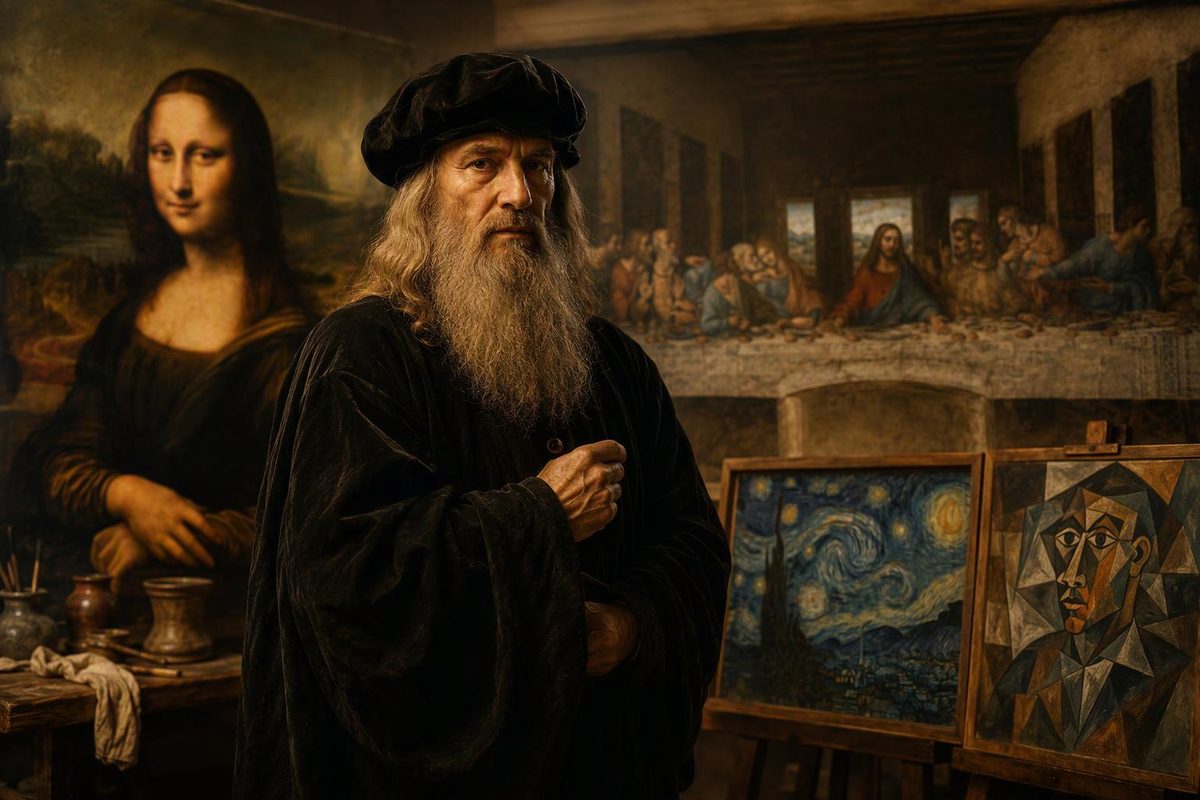
Leonardo da Vinci is our pick for the most famous painter in the world, chiefly because he painted the Mona Lisa. The Louvre describes it as “the world’s most famous painting.” That makes Leonardo a strong answer—but this is an editorial judgment, not the result of a worldwide survey of painter-name recognition.
Why Leonardo is the strongest single answer
Leonardo has more than one route into a trivia player’s memory. There is the enigmatic smile of the Mona Lisa, the long table in The Last Supper, and the notebooks filled with studies of anatomy, engineering and flying machines. The National Gallery describes him as a painter, sculptor, architect, engineer and scientist who influenced generations of artists. His reputation extends well beyond painting. National Gallery biography
The Mona Lisa also has a story that helped magnify its fame. On 21 August 1911, it disappeared from the Louvre. More than two years later, Vincenzo Peruggia, a glazier who had worked at the museum, tried to sell it to an Italian art dealer, who alerted the authorities. The Louvre says the recovery made the painting even more famous. It now sits in a protective, climate-controlled glass case in the museum’s largest room. The painting’s history and display
Then there is The Last Supper, painted in the 1490s in the refectory of Santa Maria delle Grazie in Milan. One useful trivia distinction: it is a mural, but Leonardo did not use traditional fresco technique. He worked on dry plaster so he could proceed slowly and make changes. Museo del Cenacolo Vinciano
Why Van Gogh and Picasso are also plausible answers
Vincent van Gogh has a particularly direct visual association: sunflowers. The Van Gogh Museum says he wanted to be known as the painter of sunflowers and describes him as famous “in all corners of the globe” for those paintings. That establishes broad fame, though not a head-to-head victory over Leonardo. Van Gogh Museum
Pablo Picasso belongs in the conversation through his role in modern art. He developed Cubism with Georges Braque. When Les Demoiselles d’Avignon was first exhibited publicly in 1916, some viewers regarded it as a turning point in modern art. MoMA describes its figures as composed of angular lines and flattened, splintered planes—a useful visual cue for the name Picasso. MoMA’s collection account
These are different kinds of prominence. Recognizing a painting, recalling its painter’s name and judging artistic influence are not the same task. “Most famous” also does not mean “best.”
Keep the name attached to the picture
For a quick recall prompt, use enigmatic smile → Mona Lisa → Leonardo da Vinci. If that picture does not bring the name to mind, try his second cue: The Last Supper.
Want more painter names rather than one winner? Browse 14 famous painters and their recall cues.