
How to Choose and Plan a Workplace Whodunit
Self-host when the budget is constrained and a capable organizer can absorb the preparation. Large or complex events favor professionals. Costs and access matter.
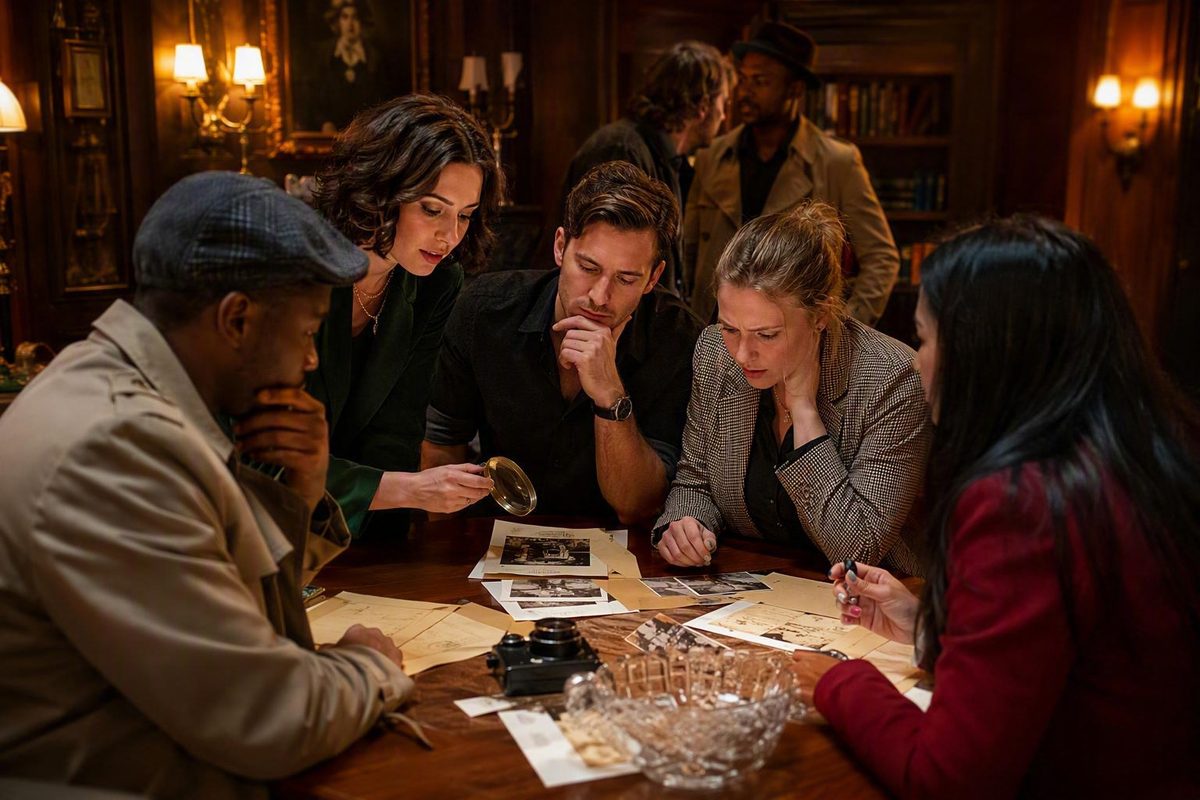
Murder mystery team building is not one standardized activity. It might be a downloadable game run by an employee, a compact puzzle challenge led by a facilitator, a theatrical dinner with professional actors, or a virtual investigation conducted in breakout rooms.
The right choice depends less on how dramatic the story sounds than on practical questions: How many people can participate meaningfully? Does anyone have to act? Who prepares the clues? What does the quoted price exclude? Can everyone access the evidence? What happens if a central character is absent or the video platform fails?
Most importantly, distinguish the activity’s mechanics from its promised benefits. A murder mystery can require coworkers to exchange information, question assumptions, solve puzzles, and agree on a verdict during the game. That does not establish that one event will produce lasting improvements in trust, communication, morale, cohesion, or job performance.
Editorial disclosure: NameIt is a separate famous-person recall game, not a seller, host, or facilitator of murder mystery team-building events. This independent informational guide compares third-party formats and does not rank or endorse a provider. Most specifications below come from provider-published pages rather than independent evaluations. Commercial details were reviewed on August 9, 2026, but prices, capacities, platforms, availability, and contract terms should be verified directly before booking. Learn what NameIt provides.
What happens during a murder mystery team-building event?
A workplace murder mystery is an interactive investigation of a fictional crime. Rather than watching a passive show, employees become part of the case. Depending on the format, they may receive individual characters, join detective teams, question suspects, inspect evidence, decode messages, solve puzzles, compare theories, and submit a final answer.
A typical event follows this sequence:
- Opening briefing: A host introduces the setting, incident, rules, boundaries, and objective.
- Role or team assignment: Participants receive characters, private information, or places in investigative teams.
- Clue rounds: Evidence, witness statements, puzzles, or plot developments are released in stages.
- Investigation: Participants question characters, share observations, test alibis, and connect clues.
- Verdict: Teams identify a suspect and may explain the motive, method, and supporting evidence.
- Reveal: The host presents the solution, explains the clues, and may announce a winning team.
Provider descriptions commonly use this broad structure, although the balance between acting and analytical work varies. One corporate-game overview describes participants as suspects, witnesses, investigators, or detectives who analyze clues and reach a conclusion before the host’s final reveal (KraftyLab’s gameplay overview).
Character-driven games emphasize role-play. A participant may receive a biography, motive, alibi, relationships, private objectives, and information that can be disclosed only at specified times. Some games invite improvisation, deception, themed clothing, or conversations conducted in character.
Puzzle-led games can require little or no acting. Teams may work through trivia, timelines, physical evidence, logic problems, codes, or secret messages. The fictional crime supplies the narrative, but participation resembles a structured team puzzle more than a theatrical performance.
The event may also be cooperative or competitive. In a cooperative version, the entire group builds one theory. In a competitive version, attendees form smaller teams that submit separate verdicts, receive scores, or compete for a winner announcement. Organizers should establish which model applies because competition changes how freely clues are shared.
These mechanics create an occasion for communication and information sharing during play. Participants may need to explain what they know, ask follow-up questions, reconcile conflicting accounts, or defend a theory. Those are observable behaviors within the activity. The reviewed provider material does not demonstrate that they translate into lasting improvements in everyday workplace communication, trust, cohesion, morale, or performance.
Compare the main formats before choosing
The central buying decision is how much responsibility to retain internally. A kit offers control and a relatively low purchase price, while a managed event may transfer preparation, facilitation, and performance to a provider. Theatrical dinners emphasize immersion; hosted puzzle games prioritize structure; virtual formats accommodate geographically distributed teams.
| Format | Typical activity | Facilitation model | Role-play intensity | Organizer workload | Indicative duration | Pricing model | Best-fit situation |
|---|---|---|---|---|---|---|---|
| Downloadable or boxed kit | Characters, scripted rounds, clues, questioning, final vote | Internal organizer | Medium to high | High | From a compact session to a full evening | Fixed kit price | Budget-conscious group with a willing host |
| Facilitator-led puzzle game | Trivia, codes, linked puzzles, evidence analysis | Professional host, remote or in person | Low to medium | Medium | Some reviewed examples last about one hour | Quote, flat fee, or per person | Compact, structured office session |
| Actor-led event | Actors advance the plot while attendees investigate | Professional cast and event team | Medium | Low to medium internally | Product-specific | Quote or attendance tier | High-profile or theatrical event |
| Murder mystery dinner | Suspect interactions and clues between meal stages | Actors, host, venue, and catering team | Medium to high | Medium | Some reviewed programs run two to three hours | Quote plus possible food and venue costs | Evening celebration |
| Live-hosted virtual game | Digital evidence, breakout investigation, hints, reveal | Remote host and sometimes technical support | Low to medium | Low to medium | Product-specific | Per person, flat rate, or quote | Geographically distributed team |
| Self-hosted virtual game | Downloaded or online materials managed by an employee | Internal organizer | Varies | High | Product-specific | Fixed fee or license | Remote group prioritizing control |
| Hybrid event | Room-based and remote attendees investigate one case | One or more hosts | Varies | High unless both audiences are managed | Product-specific | Usually quote or per person | Team unable to meet in one place |
Self-hosted kits
A downloadable or boxed kit usually supplies the script, character information, clue packets, rules, and solution. It offers control over timing, casting, tone, and location.
The organizer may still need to read the entire game, assign roles, print and sort documents, prepare props, send character information, control clue releases, answer questions, cover absences, keep time, and run the reveal. A low purchase price does not necessarily mean low internal effort.
Facilitator-led puzzle games
A puzzle-led game suits groups that want a defined activity without extensive acting. Watson Adventures, for example, describes a one-hour case in which teams answer trivia, solve interconnected puzzles, uncover secret messages, and receive questions or hints from a remote or in-person host. The provider also says that a backpack of materials is shipped to the customer (Watson Adventures’ hosted game).
This structure can fit inside a meeting or office social and places responsibility for pacing and hints with the facilitator. Confirm where materials can be shipped, what the room must provide, and whether the host joins remotely or attends in person.
Actor-led and dinner events
Actor-led events place more of the performance burden on professionals. Attendees still question suspects, collect clues, and reach a verdict, but actors manage major plot moments.
Dinner versions integrate investigation with food service. Clues or suspect interactions may appear between courses. This can create a fuller evening experience, but catering, dietary requirements, serving times, room layout, and actor movement must be coordinated. Ask whether the advertised duration includes arrival, the meal, briefing, investigation, and reveal.
Virtual and hybrid events
Virtual games may use video conferencing, digital evidence, hosts, and breakout rooms. “Virtual murder mystery” does not necessarily mean live-hosted, however. Some catalogs contain both professionally facilitated and self-hosted products.
Elevent, for example, describes a catalog spanning self-hosted puzzles and live theatrical events, with individual listings potentially supporting Zoom, Microsoft Teams, Cisco Webex, or Google Meet. Its page says events generally run 45–120 minutes, while pricing and delivery details vary by listing (Elevent’s virtual mystery catalog).
Hybrid events need additional scrutiny. A provider may advertise access for office and remote participants without demonstrating that both groups receive comparable opportunities to investigate. If room-based attendees can see physical props, hear side conversations, or question actors informally while remote colleagues cannot, the online group may become an audience.
Require a documented plan showing how both audiences will receive evidence, ask questions, obtain hints, enter verdicts, and reach a facilitator. That plan supports meaningful access; it does not guarantee identical experiences.
Scripted versus free play
A scripted game supplies dialogue, actions, or scheduled disclosures. This supports predictable pacing and reduces the risk that an essential clue will be omitted. It can also help participants who prefer clear instructions.
Free play provides character backgrounds and objectives but leaves more dialogue to participants. This distinction is practical party-planning guidance rather than an established workplace standard (Instructables’ scripted and free-play comparison).
A useful selection rule is:
- Choose a kit for budget control and flexible timing.
- Choose a facilitator-led puzzle game for compact, structured play with limited acting.
- Choose an actor-led event for theatrical immersion and less internal facilitation.
- Choose a virtual format when attendees are geographically distributed.
- Choose hybrid only when there is a documented plan for remote access to evidence, questions, facilitation, discussion, and verdict submission.
Match the format to your headcount and schedule
Published capacities are vendor-stated limits, not guarantees that every attendee will receive a substantial role. A product advertised for hundreds of people may work by placing attendees in teams that share evidence and submit one answer. That can be workable, but it is different from giving hundreds of people individual characters, motives, and plot responsibilities.
| Published example | Vendor-stated capacity | Published duration | Likely structure |
|---|---|---|---|
| Playing With Murder table game | 8 to 100+ depending on the game | 30 minutes | Compact, mostly scripted table activity |
| Playing With Murder standard kit | 8 to 100+ depending on the game | 90 minutes to a full evening | Self-hosted character and clue rounds |
| Watson Adventures hosted puzzle game | Not stated on the reviewed page | One hour | Teams solve linked puzzles with host guidance |
| AVVA in-person challenge | 10 to 1,000+ | 90 minutes | Teams of 3–12, four rounds, midpoint scores, final verdicts |
| TeamBonding dinner | 20 to 500 | Two to three hours | Professional actors, meal, clues, group solution |
Before booking, ask:
- How many people are placed in each investigative team?
- What does each person do during a round?
- Does every team receive its own evidence?
- Are clues physical, digital, projected, or delivered by actors?
- How many facilitators support the event?
- How do facilitators identify a team that is stuck or excluding members?
- Does the advertised capacity include spectators?
- What changes at the upper end of the attendance range?
Be cautious with inconsistent catalog claims. Elevent’s page title refers to 4–500 people, while its body copy says its catalog can support groups of up to 1,000. Verify the limit for the exact experience, date, platform, and hosting model rather than assuming either figure applies universally.
Sample 60-minute virtual agenda
| Time | Activity |
|---|---|
| 0:00–0:07 | Welcome, platform orientation, accessibility check, story briefing |
| 0:07–0:12 | Team assignment and evidence access |
| 0:12–0:27 | Breakout investigation: first clue set |
| 0:27–0:32 | Host update and optional hint |
| 0:32–0:47 | Breakout investigation: final clues and theory |
| 0:47–0:53 | Teams submit verdicts |
| 0:53–1:00 | Reveal, scoring, and short debrief |
A reviewed Watson Adventures virtual game follows a comparable one-hour structure using host guidance, breakout-room teamwork, puzzles, codes, hints, and a final reunion (Watson Adventures’ virtual game).
Sample 90-minute office agenda
| Time | Activity |
|---|---|
| 0:00–0:10 | Briefing, rules, and team formation |
| 0:10–0:25 | Round one: scene and initial evidence |
| 0:25–0:40 | Round two: suspect statements |
| 0:40–0:45 | Midpoint scoreboard and hints |
| 0:45–1:00 | Round three: puzzles and conflicting evidence |
| 1:00–1:15 | Round four: final deductions |
| 1:15–1:22 | Verdict submissions |
| 1:22–1:30 | Solution and winner announcement |
Sample two-to-three-hour dinner agenda
| Stage | Activity |
|---|---|
| Arrival | Character introductions and opening incident |
| First course | Initial questioning and first clue |
| Between courses | Suspect interaction and second evidence release |
| Main course | Table investigation and optional puzzle |
| Before dessert | Final witness statement or plot twist |
| Dessert | Team deliberation and verdict |
| Closing | Reveal, awards, and brief discussion |
Allow additional time for arrivals, seating, food service, accessibility needs, photographs, awards, or speeches. Confirm whether setup, arrival, the meal, briefing, and reveal sit inside or outside the provider’s published duration.
Estimate the real cost, not just the advertised price
Corporate murder mystery prices generally appear in four forms:
- Fixed-price kits: One purchase covers a stated game or player range.
- Per-person starting rates: The final rate may change with group size, date, customization, or service level.
- Published attendance tiers: A fixed amount applies to a headcount band.
- Custom quotes: The provider prices the event after learning the location, schedule, attendance, and production requirements.
These models are not directly comparable. A kit price normally buys game materials. A managed-event fee may include hosts, actors, planning, props, equipment, insurance, setup, and breakdown.
When reviewed, most standard Playing With Murder kits displayed at $49.95, with some standard products at $39.95; its listed 30-minute games were $39.95. The vendor also recommended allowing one to two weeks to prepare standard kits, creating an internal labor cost even where no staffing charge appears (Playing With Murder’s catalog).
AVVA published UK attendance tiers beginning at £1,000 plus VAT for 10–50 attendees and rising to £4,500 plus VAT for 401–500, with groups of 501 or more priced on application. It also said transport and setup fees might apply. Its stated package included hosts, facilitators based on group size, event management, AV equipment, props, clues, planning, risk assessments, public liability insurance, setup, and breakdown; venue, furniture, and staging were excluded as standard. The signed contract and applicable local requirements control the final legal and financial terms (AVVA’s in-person pricing and inclusions).
Virtual prices also differ by product. AVVA listed several live-hosted experiences from $12 per person and described a typical range of $12–$50 depending on group size. These are starting figures, not final quotes (AVVA’s virtual listings).
Elevent described an approximate marketplace range of $30–$150 per person, with many events around $50 and some flat-rate options. Those figures cover a different catalog and should not be averaged with AVVA’s into a general market price.
Other providers do not publish a complete price. TeamBonding directs buyers to request a quote for its dinner program, while The Murder Mystery Company uses consultation and personalized pricing for private events (The Murder Mystery Company’s private-event overview).
Total-cost worksheet
| Cost category | Questions to answer |
|---|---|
| Kit or provider fee | Is it fixed, per person, tiered, minimum-spend, or quote-only? |
| Tax or VAT | Is tax included in the displayed price? |
| Travel | Are mileage, rail, flights, lodging, parking, or travel time charged? |
| Shipping | Are materials sent to one organizer or every participant? |
| Venue | Is room hire separate? Are early access and overtime billable? |
| Catering | Does the fee include food, beverages, service, and dietary alternatives? |
| Furniture and staging | Are tables, chairs, risers, screens, or staging included? |
| Power and Wi-Fi | Must the venue provide power or dedicated bandwidth? |
| AV equipment | Who supplies microphones, speakers, screens, and adapters? |
| Platform fees | Is a conferencing license or webinar upgrade required? |
| Setup and breakdown | Are these included, and how much venue time do they require? |
| Overtime | What happens if dinner, speeches, or the investigation runs late? |
| Costumes and props | Are they required, optional, provided, shipped, or purchased internally? |
| Internal organizer time | How many paid hours will preparation, testing, and hosting consume? |
| Contingency | What costs arise after an absence, delay, postponement, or technical failure? |
A “from” price is not a final quote. Ask the provider to state the currency, taxes, headcount assumptions, staffing, equipment, travel, shipping, cancellation terms, and exclusions. Date-stamp the quote and verify it again before approval.
Decide whether to self-host or hire professionals
The practical dividing line is not simply cheap versus expensive. It is whether the organization has someone with the time, confidence, and authority to prepare and run the event.
| Task | Self-hosted event | Professionally managed event |
|---|---|---|
| Review the full game and solution | Internal organizer | Usually provider |
| Print and sort materials | Internal organizer | Provider or shipped in advance, if included |
| Assign characters or teams | Internal organizer | Provider may advise or assign |
| Invite participants | Internal organizer | Shared responsibility |
| Prepare clues, props, and room | Internal organizer | Provider may handle some items |
| Explain rules | Internal host | Professional host or actor |
| Release clues and keep time | Internal host | Professional facilitator |
| Answer questions and supply hints | Internal host | Provider |
| Replace absent characters | Internal organizer | Provider may adapt if contracted |
| Manage AV or platform | Internal organizer | Provider, venue, or shared |
| Facilitate verdict and reveal | Internal host | Professional host |
| Setup and breakdown | Internal team | May be included |
| Risk documentation and insurance | Organization | Provider may supply specified documents or cover |
| Technical failure | Internal organizer | Technical support may be included |
What self-hosting requires
For a kit, the organizer should:
- Read the full game, including the solution.
- Identify essential and optional characters.
- Print, label, and sort role packets.
- Prepare clue envelopes or digital releases.
- Assign roles without relying on workplace stereotypes.
- Send invitations and character information.
- Explain costume and acting expectations.
- Prepare props, signs, name badges, and room layout.
- Test links, files, screens, audio, and printers.
- Explain rules and content boundaries.
- Control time and clue releases.
- Answer questions without exposing the solution.
- Adapt to late arrivals or absences.
- Collect verdicts and facilitate the reveal.
Preparation should begin early. Red Herring Games advises hosts to review every component and complete printing and clue preparation in advance, while sending invitations several weeks ahead when attendees may need costumes (Red Herring Games’ hosting guidance).
Character-dependent stories are particularly vulnerable to absences. Assign essential parts to dependable volunteers, but ask:
- Can an essential character be removed?
- Is there a substitute-character packet?
- Can private clues be transferred?
- Can the host read a missing person’s statements?
- Does the script adapt to a smaller headcount?
- What happens when someone arrives after a clue round?
- Can an attendee switch from acting to an analytical role?
Do not make the internal host a central suspect unless the game is specifically designed for it. Someone needs access to the solution and enough attention to monitor pacing, questions, and participation.
What a managed provider may handle
Possible inclusions include:
- Actors or hosts
- Event planning and scheduling
- Participant communications
- Printed or shipped materials
- Props and clue sets
- AV equipment
- Venue liaison
- Risk assessments
- Public liability insurance
- Setup and breakdown
- Remote technical support
- Scoring and winner announcements
These are possible inclusions, not universal standards. Obtain a written list and check the contract.
As a practical rule, self-host when the budget is constrained and a capable organizer can absorb the preparation. Hire professionals when the event is large, high-profile, theatrical, logistically complex, dependent on tight timing, or short on internal planning capacity.
Design participation without forcing everyone to perform
Acting and costumes are format choices, not inherent requirements of murder mystery team building.
A full-character game may give participants private information, motives, alibis, relationships, secrets, and objectives. It may ask them to misdirect others, question colleagues in character, or speak during a final accusation. A puzzle-led game can instead center on evidence, codes, timelines, and team discussion.
Ask participants privately how they prefer to contribute. Do not assign parts based on assumptions such as “salespeople will enjoy performing,” “introverts should take notes,” or “the senior manager should be lead detective.” Personality stereotypes and organizational rank are poor substitutes for consent.
Useful responsibilities include:
- Interviewer: Leads prepared questions.
- Clue tracker: Records what each clue appears to establish.
- Evidence manager: Organizes physical or digital materials.
- Puzzle solver: Works on codes, logic, or wordplay.
- Timeline keeper: Builds the sequence of events.
- Skeptic: Tests the leading theory against conflicting evidence.
- Note-taker: Captures observations and unresolved questions.
- Spokesperson: Presents the verdict, if comfortable doing so.
These responsibilities may rotate or be shared. Written verdicts and questions should be available for people who do not want to address the full group.
Provide meaningful alternatives for employees who do not want to:
- Act or improvise
- Wear a costume
- Pretend to deceive coworkers
- Interrogate a manager or direct report
- Make a public accusation
- Perform an accent or persona
- Be photographed in costume
- Engage with a fictional murder theme
- Speak to the full group
A participant who declines acting should not be relegated to watching. Evidence analysis, clue management, written questions, puzzles, and private team discussion can contribute directly to the result.
Facilitators can support quieter participants through structured turns, written idea collection, small-team discussion, and neutral prompts such as, “Is there evidence we have not considered?” Invitations to contribute should not become demands to perform.
Workplace power dynamics require particular care. Make costumes, public performance, deception, and accusation genuinely optional.
If fictional murder is a poor cultural fit, alternatives include:
- A heist investigation
- Corporate espionage
- A missing artifact
- A stolen invention
- A sabotaged awards ceremony
- A non-violent historical mystery
- A general detective puzzle
The objective is structured investigation, not necessarily a death-centered story.
Check accessibility, content, venue, and technology
Provider pages do not consistently establish specific accommodations. Treat accessibility as a procurement requirement rather than an assumption.
Accessibility-first questions
Ask the provider:
- Can wheelchair users reach every activity area?
- Can the event be completed while seated?
- Are accessible tables and seating positions available?
- Are microphones used for hosts and actors?
- Are live or automated captions supported?
- Can scripts and questions be supplied in writing?
- Do audio clues have transcripts?
- Can evidence be supplied in large print?
- Are digital files compatible with screen readers?
- Do images have text alternatives?
- Does any puzzle depend only on color?
- Can high-contrast or color-labeled evidence be provided?
- Are sudden sounds, music, flashing visuals, or lighting effects used?
- Is there a lower-sensory option?
- Can instructions be provided early?
- How much rapid reading, memory, improvisation, or overlapping conversation is required?
- Is plain-language or translated material available?
- Can multilingual teams receive additional time?
- Are dietary requirements handled if food is involved?
- Can someone participate fully without acting or public speaking?
- Is a quiet space available?
- Can breaks be taken without missing essential clues?
Do not settle for a broad statement that the activity is “inclusive.” Ask what the provider will supply for needs disclosed through an appropriate, private process.
Content review
Screen the selected story for:
- Fictional violence and death
- Weapons
- Blood or body-themed imagery
- Sexual content
- Alcohol or intoxication
- Harassment or coercion
- Stereotypes and caricatures
- Romantic pairings
- Family trauma
- Culturally specific jokes
- Accents
- Religious or political material
Ask for a content rating, synopsis, sample character card, or representative evidence sheet before assigning participation. One provider advertises content across a G-to-R range, demonstrating why the selected version—not merely the provider’s brand—must be confirmed (The Murder Mystery Company’s corporate-event description).
Some vendor-suggested add-ons involve restraints, carrying people, floor movement, timed collection of objects, or body outlines. If considered at all, these should undergo the organization’s own qualified consent, safety, accessibility, dignity, workplace, and HR review rather than being treated as default activities (examples documented by Red Herring Games).
In-person venue checklist
Confirm:
- Legal and comfortable room capacity
- Table and chair layout
- Step-free access and accessible restrooms
- Space for actors and participants to move
- Clear sightlines to the host and screen
- Lighting sufficient to read evidence
- Power outlets and extension requirements
- Reliable Wi-Fi
- Microphones, speakers, projector, screen, and adapters
- Catering flow and service timing
- Loading, parking, and setup access
- Storage for cases, costumes, and props
- Setup and breakdown windows
- Noise restrictions and neighboring events
- Whether venue, furniture, staging, and AV are included
In one concrete example, AVVA states that the client venue must provide power, reliable Wi-Fi, and sightlines to the host and projector, while venue, furniture, and staging are not standard inclusions. Requirements like these belong in both the budget and venue brief.
Virtual and hybrid checklist
For a virtual event, verify:
- The exact supported platform
- Who supplies the account
- Breakout-room creation and reassignment
- Host and technician responsibilities
- Caption support
- Browser, computer, camera, and audio requirements
- Mobile-device limitations
- Firewall and guest-access restrictions
- File-download permissions
- Security settings and meeting passwords
- Whether sessions are recorded
- How participant names and uploaded material are handled
- A dial-in or alternative-access option
- What happens if the host, platform, or participant connection fails
Zoom, Microsoft Teams, Cisco Webex, and Google Meet appear among provider-listed options, but support varies by event. “Delivered online” is not enough; obtain the platform and feature requirements in writing.
For hybrid participation, use separate room and remote facilitators where feasible. Give both groups access to evidence, questioning, hints, timers, and verdict submission. Avoid relying on one laptop at the end of a conference table. Assign someone to monitor remote chat and protect online speaking turns.
Use a booking checklist and evaluate the event honestly
A procurement checklist should cover the experience, logistics, risk, and final cost.
Booking checklist
Confirm in writing:
- Exact minimum and maximum headcount
- What happens outside the booked attendance band
- Typical and maximum subteam size
- Facilitator-to-participant structure
- Number of hosts, actors, technicians, or table leads
- Total event duration
- Whether arrival, briefing, breaks, reveal, and awards are included
- Setup and breakdown time
- Role-play and improvisation intensity
- Whether costumes are required, optional, or supplied
- Content rating and sensitive themes
- Customization limits
- Included physical and digital materials
- Shipping addresses, costs, and deadlines
- Replacement process for delayed materials
- Travel fees and geographic restrictions
- Tax or VAT
- Venue, furniture, staging, power, Wi-Fi, and AV needs
- Catering responsibilities
- Supported platforms and required licenses
- Accessibility accommodations
- Insurance and risk documentation
- Payment schedule and deposit
- Cancellation, refund, and rescheduling terms
- Overtime charges
- Final price and exclusions
Also ask what happens if:
- A key character is absent
- Attendance is higher or lower than booked
- Materials arrive late
- The venue changes
- Wi-Fi fails
- A host or actor becomes unavailable
- A participant cannot access the evidence
- Catering delays a clue round
- A remote attendee loses connection
- The event must stop early
Very large capacity claims require another layer of questioning. Ask how attendees are divided, how many facilitators support them, how questions are answered, whether clue sets are duplicated, and what meaningful responsibility each person can receive. Capacity describes the number a provider says it can process; it does not prove depth of participation.
Debrief observable behavior
A short debrief can support reflection without claiming that the event transformed the team. Useful questions include:
- Which information was shared early, and which was withheld?
- How did the team decide whether a clue was reliable?
- Which assumptions changed after new evidence appeared?
- Did the group test more than one theory?
- How was disagreement handled?
- Who influenced the final verdict?
- Did everyone have a route to contribute?
- What would the team do differently in another investigation?
Keep the discussion bounded to what participants observed. Similarities to work may be explored, but solving a fictional case does not prove leadership ability, trustworthiness, or job competence.
Anonymous post-event survey
Use a short survey with optional comments:
- I had a meaningful way to participate.
- I understood what I was expected to do.
- The clue difficulty was appropriate.
- I felt comfortable with the theme and interactions.
- My access needs were met.
- My team shared and discussed information.
- The event was enjoyable.
- I would consider a similar format again.
- Which part best supported your participation?
- What should be changed?
A positive survey can show that attendees enjoyed, valued, or felt involved in the experience. It cannot by itself demonstrate lasting improvements in trust, communication, cohesion, morale, or job performance.
Frequently asked questions
How long does murder mystery team building usually take?
Reviewed examples range from 30 minutes for compact table games to one hour for some hosted puzzle or virtual games, 90 minutes for one structured in-person challenge, and two to three hours for an actor-led dinner. Some self-hosted kits can occupy a full evening. These are provider-published examples, not universal duration ranges.
Add time for arrival, instructions, access checks, meal service, breaks, setup, breakdown, awards, and a debrief. Ask whether the published duration includes the briefing and reveal.
How much does a corporate murder mystery cost?
Costs range from fixed-price downloadable kits to managed-event fees. Reviewed examples included kits around $40–$50, virtual starting rates from $12 per person, higher marketplace estimates, attendance-tier pricing, and quote-only actor-led programs. All are time-sensitive vendor figures rather than a market-wide average.
The final budget may also include tax or VAT, travel, shipping, venue hire, catering, furniture, staging, AV equipment, platform fees, costumes, setup, overtime, and internal organizer time. Compare written final quotes rather than headline starting prices.
Can a murder mystery work for remote or hybrid teams?
Yes. Virtual formats can use video conferencing, breakout rooms, digital evidence, live hosts, puzzles, and online verdict submissions. Confirm whether the selected product is live-hosted or self-hosted and whether the platform supports every required feature.
Hybrid delivery is more demanding. Room-based and remote participants need meaningful access to clues, questions, hints, discussion, and verdict submission. Separate facilitation and an explicit remote-participation plan can reduce the risk that online attendees become spectators.
Do employees have to act or wear costumes?
No. Acting and costumes depend on the format. Character-led games may involve improvisation, private objectives, and themed clothing, while puzzle-led formats can focus on evidence, codes, and team discussion.
Make performance optional and provide meaningful analytical responsibilities for people who prefer not to act, dress up, deceive colleagues, or speak publicly.
Does murder mystery team building actually improve teamwork?
The gameplay can require communication, observation, information sharing, deduction, and joint decision-making during the event. That makes these behaviors visible and available for discussion.
The reviewed provider material does not establish that a murder mystery produces lasting improvements in workplace trust, communication, cohesion, morale, or performance. Evaluate immediate participation, accessibility, comfort, enjoyment, and perceived collaboration without treating a successful event as proof of organizational change.
The best workplace whodunit is not necessarily the most theatrical option or the one advertising the largest capacity. Book only when:
- The format fits the group’s comfort and culture.
- The full cost, contract terms, and inclusions are verified.
- Everyone has a meaningful but optional route to contribute.
- Accessibility and content requirements are satisfied.
- The schedule includes realistic setup, play, and transition time.
- Absence, shipping, venue, and technical contingencies are covered.
- Success will be judged through participation, comfort, and event quality—not marketing claims alone.