
Meet the Racing Star at the Center of Talladega Nights
Ricky does not officially win the final race: he and Jean are disqualified after their on-foot finish, making Cal Naughton Jr. the winner.
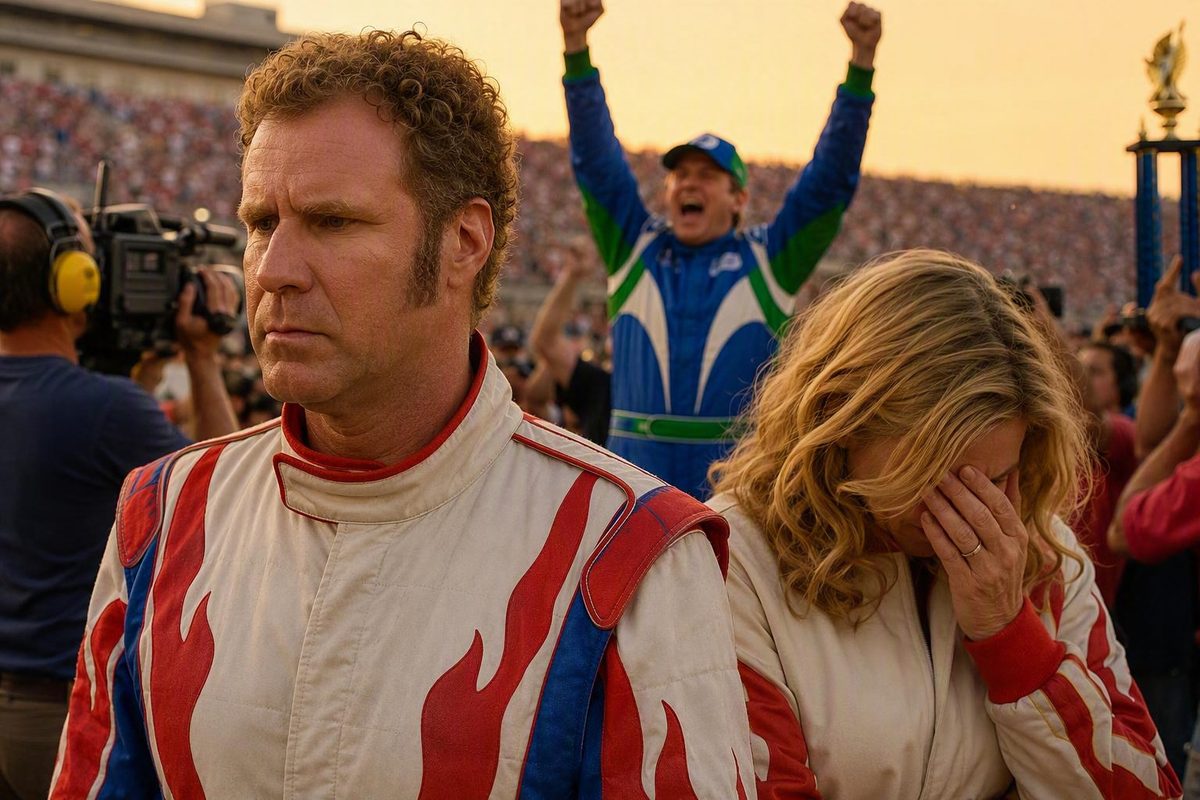
Ricky Bobby is not a real NASCAR driver. He is the fictional racing star played by Will Ferrell in the 2006 sports comedy Talladega Nights: The Ballad of Ricky Bobby. His obsession with winning drives both the comedy and his character arc: after success, a crash and a collapse in confidence, Ricky must decide whether finishing first is the only thing that gives him value.
The short answer: Who is Ricky Bobby?
Ricky Bobby is the protagonist of Talladega Nights, a NASCAR satire directed by Adam McKay and co-written by McKay and Will Ferrell. Ferrell portrays Ricky as a talented but immature driver whose fame, relationships and self-image initially depend on victory.
The film’s races, championships and versions of its drivers are part of a fictional comedy, not real NASCAR history.
| Fact | Detail |
|---|---|
| Character | Ricky Bobby |
| Fictional occupation | NASCAR driver |
| Actor | Will Ferrell |
| Film | Talladega Nights: The Ballad of Ricky Bobby |
| Release year | 2006 |
| Director | Adam McKay |
| Co-writers | Adam McKay and Will Ferrell |
| US rating | PG-13 |
| Approximate runtime | 108 minutes |
IMDb’s film listing identifies the movie as a 2006 PG-13 release, credits McKay as director and McKay and Ferrell as writers, and lists a runtime of 1 hour 48 minutes.
Ricky Bobby’s story: rise, crash and comeback
Spoiler warning: Major plot developments follow.
Ricky begins the story as a successful racing star. His friend and teammate, Cal Naughton Jr., supports him on the track and helps him remain on top. Their arrangement works while Ricky keeps winning and Cal accepts the supporting role.
The balance changes when Jean Girard arrives. Girard is a French Formula One driver whose talent threatens Ricky’s position. The rivalry is deliberately exaggerated: Talladega Nights uses their clash to parody racing celebrity, macho confidence and national stereotypes. Netflix’s synopsis likewise frames the story around Ricky’s status being threatened by a French Formula One champion.
Ricky’s downfall accelerates after a crash. Although he survives, his confidence does not. Fear follows him back onto the track, and the identity he built around being unbeatable begins to collapse. His career and personal relationships deteriorate because he has no stable sense of himself outside winning.
His attempted comeback is therefore about more than returning to racing. Ricky must rebuild his confidence while confronting the weakness in his all-or-nothing worldview. He still wants to compete, but the story gradually separates courage from guaranteed victory. His comeback matters because he learns to act without knowing that he will finish first.
The three relationships that define Ricky
Three characters place different kinds of pressure on Ricky. Cal tests friendship and loyalty, Jean turns competition into a crisis of identity, and Reese supplies the simplistic philosophy Ricky must eventually outgrow.
| Character | Actor | Relationship to Ricky | Role in his development |
|---|---|---|---|
| Cal Naughton Jr. | John C. Reilly | Friend and teammate | Tests whether friendship can survive rivalry, resentment and changing roles |
| Jean Girard | Sacha Baron Cohen | Principal racing rival | Destabilizes Ricky’s confidence and forces him to face the possibility of losing |
| Reese Bobby | Gary Cole | Ricky’s father | Gives Ricky his win-at-all-costs creed, then exposes how flimsy that creed is |
Cal is not merely a sidekick. His willingness to help Ricky win creates an unequal friendship, and the consequences reveal how much Ricky takes loyalty for granted. Jean functions as Ricky’s opposite: controlled where Ricky is chaotic and confident enough to puncture Ricky’s swagger. Reese, meanwhile, shapes Ricky through one memorable but deeply unhelpful rule about success. The actors and character roles appear in the film overview for Talladega Nights.
Together, the three can be read as different pressures around loyalty, competition and achievement. That is an interpretation of the story, not a documented formula from the filmmakers, but it helps explain why Ricky’s growth requires more than defeating one opponent.
What “If you ain’t first, you’re last” means in the film
“If you ain’t first, you’re last” comes from Ricky’s father, Reese Bobby, within the fictional story. Ricky adopts it as a complete philosophy: first place means success, while every other result means failure.
The line is funny because Ricky treats a false dichotomy as serious life guidance. It gives him confidence while he is winning but leaves him unable to cope with setbacks. If second place and last place are emotionally identical, then one defeat can destroy the identity he built around being superior.
The crucial reversal comes when Reese later admits that the statement did not make sense. That admission undercuts the rule guiding Ricky’s career: what sounded like hard-edged wisdom turns out to have been a stray remark that Ricky elevated into doctrine. This reversal is documented in the film’s plot overview.
The reversal is central to both the joke and Ricky’s development. He does not need a better slogan; he needs a broader definition of success.
Does Ricky Bobby win the final race?
No. Ricky Bobby does not officially win the final race.
After Ricky and Jean wreck their cars, they leave the vehicles and run toward the finish line. Their on-foot contest provides the scene’s comic and emotional climax, but it does not count as a valid racing result. Both men are disqualified, and Cal Naughton Jr. is declared the official winner, according to the film’s plot overview.
The distinction matters. Ricky achieves a personal breakthrough, not a sanctioned victory. He confronts Jean, persists after the crash and no longer needs the official result to prove that he matters.
That reverses Ricky’s original worldview. At the beginning, anything other than first place is worthless to him. By the end, he can lose officially and still gain something meaningful. Cal’s win also resolves the tension in their friendship: the teammate who spent so long helping Ricky finish first finally receives the recorded victory himself.
Talladega Nights facts at a glance
The film’s basic production details appear in the opening fact box, but its runtime deserves qualification. IMDb lists 1 hour 48 minutes, Apple TV lists 1 hour 47 minutes, and Rotten Tomatoes lists 1 hour 50 minutes. Describing the film as approximately 108 minutes acknowledges that the supplied platform listings range from about 107 to 110 minutes.
For a snapshot of reception, Rotten Tomatoes displayed a 71% critic score from 185 reviews and a 73% audience score from more than 250,000 ratings. These are changeable aggregates of critic reviews and user ratings, not permanent or objective measurements of the film’s quality.
Current streaming recommendations are not included because availability varies by country and date.
The recognizable Ricky Bobby costume
A recognizable Ricky Bobby costume starts with a colorful, sponsor-covered racing uniform. The clearest visual shortcut is a Wonder Bread-style racing suit with a matching cap. This is informal costume inspiration, not an official or screen-accurate wardrobe specification.
Basic outfit
- Colorful, sponsor-covered racing jacket or jumpsuit
- Matching racing pants if the suit is not one piece
- Wonder Bread-style branding
- Matching cap
- Simple white or dark athletic shoes
Optional additions
- Racing helmet
- Racing shoes
- White gloves
- Sports sunglasses
- Trophy
- Toy cougar
You do not need every accessory. The suit, sponsor graphics and cap do most of the recognition work; props simply make the reference clearer or add another joke. A Ricky Bobby guide from Carbon Costume also centers the outfit on the Wonder Bread-branded uniform and hat, with racing shoes and a helmet as additions.
The supplied Carbon Costume and Costume Wall guides use affiliate product links and may earn commissions from qualifying purchases. Their recommendations do not establish that an item is officially licensed, high quality or accurate to the clothing used on screen.
Ricky Bobby remains memorable because his biggest joke is also his central flaw. He is a fictional racing champion who believes only first place can make him somebody, and that belief helps cause his collapse. The ending matters not because Ricky officially wins—he does not—but because he finally begins to separate his identity from the result.